



We write to preserve what happened, but also to create what never did. And when we read, we do something stranger still: we enter a world made by another mind and, for a while, live there.
Years ago, I used to write fragments.
Not stories, necessarily. Not even complete thoughts. Just fragments — sentences in margins, pieces of emotions I could not carry for very long inside my heart. Sometimes they were only a few words. Sometimes a paragraph. Sometimes nothing more than a line that seemed important at midnight and meaningless by morning.

Someone once asked me, “Why do you write this?”
I remember my answer.
“We write when something inside us refuses to stay silent.”
Years later, when I had stopped writing, that person gave those words back to me.
Perhaps that is one of the strange things about words. We think we leave them behind when we write them. But sometimes they wait for us. They survive our silences. They return when we need them most.
And perhaps this is where writing begins — not with the desire to be a writer, nor with the expectation of praise, but with the inability to remain entirely silent.
We write because something within us demands a form.
A memory demands a sentence. A grief demands a name. A dream demands a landscape. A fear demands an explanation. A hope demands somewhere to live.
Writing gives these things a world.
That world may be real. It may be imagined. It may be somewhere between the two.
And this, I think, is the deeper reason we write: we do not merely preserve the world; we create worlds.
The world that words make
A diary may preserve an afternoon that would otherwise disappear. A newspaper may preserve an event for a generation that did not witness it. A novel may create a village that never existed. A poem may give shape to a feeling for which there was no language before.
The written word can document reality, but it can also invent another reality.
That distinction matters.
History tells us what happened. Literature asks what it felt like to be there.
A report can tell us that it rained. A story can make us hear the rain against a tin roof.
A record can tell us that someone was alone. A novel can make us sit beside that person in the darkness.
Facts tell us about the world.
Stories allow us to enter it.
This is not simply a poetic idea. Psychology has spent decades examining what happens when people enter narrative worlds. Researchers have found that reading fiction can engage some of the same cognitive processes involved in understanding other people — their motives, emotions, intentions and perspectives. A meta-analysis published in the Journal of Experimental Psychology: General, for instance, examined 14 studies and found that fiction readers performed somewhat better on measures of social cognition than people who read nonfiction or did not read at all, while also noting that more research is needed to establish how far such effects translate into everyday behaviour.
Raymond Mar, a psychologist who studies fiction and social cognition, has described the process in simple terms: to understand a story, we have to understand its characters, their motivations, reactions and goals. In doing so, we may also practise understanding people outside the story.
Perhaps, then, reading is not an escape from reality.
Perhaps it is rehearsal for reality.
To read is to live
There is something extraordinary about opening a book.
The room remains the same. The chair remains beneath you. The clock continues to tick. The city outside continues with its traffic, arguments, celebrations and ordinary noise.
And yet, somewhere between one page and the next, you leave.
You enter a house you have never seen.
You walk through streets that do not exist.
You meet people who were never born.
You experience their fears without having suffered them, their happiness without having earned it, their losses without having known their names.
For a few hours, their lives become available to you.
That is why I think reading is more than consuming words.
Reading is living inside someone else’s imagination.
A writer creates the door.
The reader opens it.
The writer builds the river, the cottage, the forest, the city, the room, the night.
The reader walks in.
And perhaps this is why some books remain with us long after we have forgotten their plots. We do not remember only what happened. We remember where we were while reading them.
We remember the weather of the story.
We remember the person we were when we first encountered it.
We remember the world.
The strange intimacy of fiction
A good story does something peculiar: it makes an invented person emotionally real.
We know the character does not exist outside the page, and yet we worry about them.
We wait for them.
We miss them.
Sometimes we grieve them.
Psychologists have long been interested in this attachment to fictional characters. Research on engaging characters suggests that complexity, interest and the reader’s capacity to become immersed in imagined worlds all play a role in making fictional people compelling.
This is why a book can make a stranger’s life feel intimate.
The character may belong to another century, another country, another culture, another social class, another reality entirely. Yet the interior life of that person becomes accessible to us.
We are temporarily given another pair of eyes.
And perhaps that is one of literature’s quietest powers: it allows us to inhabit lives we could never otherwise live.
We can be old when we are young.
Poor when we are wealthy.
Lonely when surrounded by people.
A soldier when we have never held a weapon.
A mother when we have never had a child.
A person on the other side of the world.
A person on the other side of history.
A person we might otherwise never have understood.
Stories cannot automatically make us better people. Research on fiction and empathy is more complicated than the popular claim that “reading makes you empathetic.” Some studies have found benefits, while others have produced smaller or inconsistent effects. But the evidence does support the idea that narrative engagement can exercise perspective-taking — the attempt to understand the world from another person’s position.
And perhaps sometimes that is enough.
To try to see.
What happens when we write ourselves
If reading lets us inhabit another person’s world, writing allows us to construct our own.
This is where writing becomes deeply personal.
Before an emotion becomes a sentence, it can be shapeless. Anger may simply be anger. Grief may be an ache without architecture. Memory may arrive in fragments.
Writing gives it sequence.
It asks: What happened?
Then: Why did it happen?
Then, perhaps: What did it mean?
Psychologist James Pennebaker’s pioneering work on expressive writing has examined precisely this relationship between language and difficult experiences. In classic experiments, people who wrote about traumatic or emotionally significant experiences showed improvements in mood and, in some studies, health-related outcomes compared with those asked to write about neutral subjects. Subsequent research has made clear that the effects are neither universal nor magical, but there is substantial literature suggesting that putting difficult experiences into language can help people organise and process them.
There is something almost elemental about that.
We take what is inside us and put it outside us.
The thought becomes a sentence.
The sentence becomes a paragraph.
The paragraph becomes a story.
And suddenly something that existed only as pain, memory or confusion has shape.
Perhaps writing does not always heal.
But sometimes it helps us see the wound.
And sometimes seeing is the beginning of understanding.
Not every writer is writing for applause
There is a tendency to imagine the writer as someone sitting before a blank page in search of beautiful sentences.
But behind much of the writing we admire there is something less beautiful.
Pain.
Memory.
Deception.
Loneliness.
Hope.
Endurance.
Sometimes even a lie.
The polished sentence may have been born from an unpolished life.
The beautiful story may have emerged from something the writer could not bear to say plainly.
We often praise the finished work without knowing what had to be endured to create it.
That is why I have never been entirely convinced that the purpose of writing is praise.
Praise belongs to the reader.
Writing belongs first to the necessity that produced it.
Some people live in words.
Some live to write them.
Some endure by reading them.
Some simply admire them.
But every writer, in some way, is trying to make something visible.
A feeling.
A memory.
A possibility.
A version of the world.
Or perhaps a world that exists nowhere except in the mind.
The world that never existed
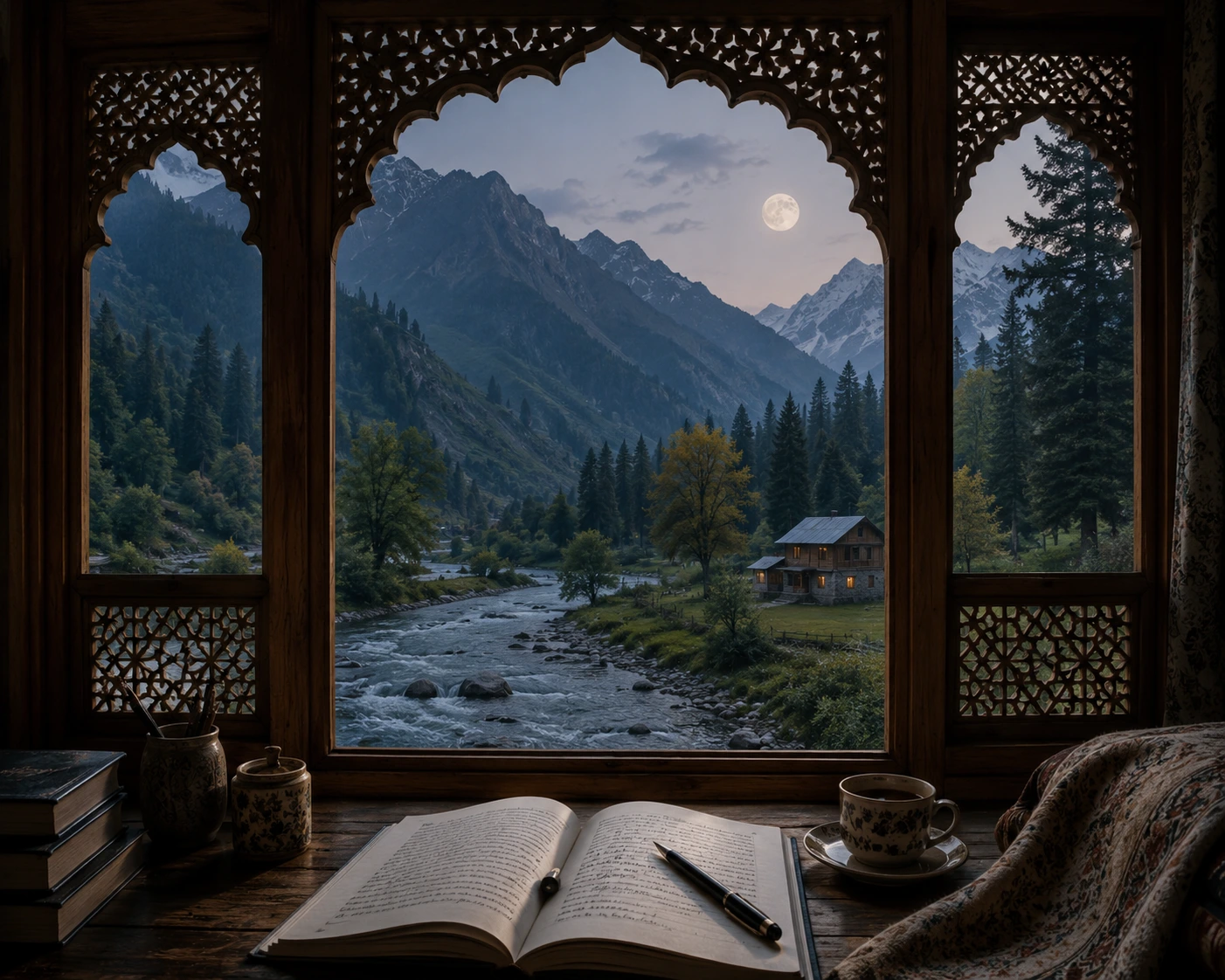
I sometimes imagine living in a cottage beside a river, somewhere deep in the remote forests of Sonamarg.
There would be no traffic outside the window.
No buildings pressing against the horizon.
Only a river moving through the valley, trees standing quietly on the slopes, the smell of wet earth, and the moon appearing above the mountains after dark.
In reality, I live in the cityscape of Srinagar, among buildings, roads, traffic and the familiar density of urban life.
The cottage does not exist.
At least not in the form in which I imagine it.
But when I write about it, something changes.
I can see the river.
When I read about forests, I can enter them.
When I write about the moon and the night sky, I can stand beneath them.
For a moment, I am there.
That place may be imaginary, but the experience of imagining it is real.
And perhaps this is what literature has always done.
It has given human beings places to go when the physical world is insufficient.
A person trapped in a room can cross an ocean.
A prisoner can travel through centuries.
A lonely person can sit beside a fictional friend.
A child can become an astronaut.
An old man can become young again.
A person living in a crowded city can wake up beside a river in a forest that exists only because someone wrote it into existence.
The world of words has no geography.
So, why do we write?
Perhaps the question is not really why we write.
Perhaps the better question is: what happens to a world once it is written?
It stops belonging entirely to the writer.
The writer may create a character, but the reader gives that character a face.
The writer may describe a river, but the reader hears its water.
The writer may write about loneliness, but somewhere another person recognises their own.
That is the strange transaction between writer and reader.
One person creates.
Another inhabits.
One offers a world.
Another chooses to live inside it.
And perhaps that is why writing is more than preservation.
We do not write only to remember what was.
We write to imagine what could be.
We write because there are worlds inside us that have nowhere else to go.
We write because silence cannot always carry what we carry.
We write because memory is fragile.
Because reality is incomplete.
Because sometimes the world around us feels built on nothingness, and we need to construct something that feels real — even if that reality exists only within the heart, on a page, inside a book, or in someone else’s words.
And when we read, we accept the invitation.
We enter.
We breathe the air of another imagination.
We walk through its streets.
We sit beside its rivers.
We inherit its memories.
For a little while, another person’s world becomes our world.
That, perhaps, is the oldest magic of writing.
A writer creates a world with words.
A reader gives it a life.
And somewhere between the two, fiction becomes real enough to be lived.