



Road accidents are becoming so familiar in Kashmir that the danger of treating them as routine is itself becoming a public safety concern. A collision is reported, victims are taken to hospital, police register a case or begin an inquiry, and attention soon moves elsewhere. But every fatal crash raises a question that deserves a clear answer: what exactly caused it, and who was responsible?
Two recent incidents in and around Srinagar and Budgam bring that question into sharp focus.
On September 12, 29-year-old Naseer Ahmad Mir and his three-year-old son, Hadi, were killed in a road accident in the Soibugh area of Budgam. Naseer’s wife, Dilshada Akhter, was critically injured. Four days later, the child’s grandfather, 62-year-old Ghulam Hassan Mir, collapsed at the graveyard while attending the funeral rites and was declared dead on arrival at a hospital. Reports said the family was mourning the loss of the father and his young son when the grandfather died.
On the intervening night of Tuesday and Wednesday, another fatal collision was reported in Raj Bagh, Srinagar, where 58-year-old Abdullah Rehman Dar died after an auto-rickshaw and a Venue car collided. Police have taken cognisance of the incident and further investigation is under way.
These are not simply statistics for a road-safety report. Behind every crash is a family that has to live with its consequences.
But grief alone cannot be the end of the process. Every fatal road accident should be investigated with the seriousness of an incident in which a life has been lost.
If there is CCTV footage covering the stretch where a collision occurred, investigators should examine it. If shops, houses, traffic cameras or other establishments in the vicinity have recordings, those should be secured before footage is overwritten. Eyewitnesses should be identified and their accounts recorded. The condition of the vehicles, braking systems, road markings, visibility, speed and other relevant circumstances should be examined wherever appropriate.
The objective should not be to blame someone before the facts are established. It should be to establish the facts properly.
That distinction matters. In the Budgam accident, reports indicate that the motorcycle carrying Naseer, his wife and their young son collided with a car. Police have been investigating the circumstances of the crash. What matters now is that the investigation should establish, through evidence, how the collision occurred and whether any driver’s conduct contributed to it.
The same principle applies to the Raj Bagh collision. Police should determine, based on available evidence, how the auto-rickshaw and car came into collision and whether speed, lane discipline, negligent manoeuvring, road conditions or any other factor played a role.
There is also a wider problem that cannot be solved through accident investigations alone.
A driving licence is proof that a person has been authorised to drive. It is not a licence to speed, overtake dangerously, ignore traffic signals, drive aggressively or assume that other road users will make way.
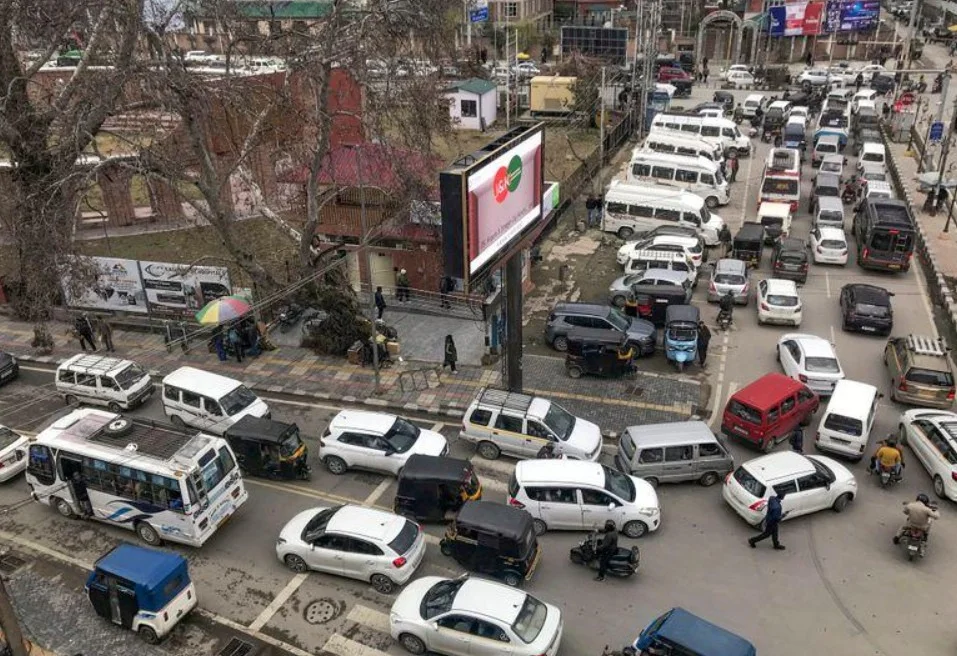
Yet the behaviour of some motorists suggests that once they obtain a licence, the responsibility that comes with it is forgotten. Rules become negotiable. Speed limits become suggestions. Mobile phones, unsafe overtaking, wrong-side driving and impatience at intersections are too easily normalised.
This is where enforcement has to become more than a post-accident exercise.
Traffic police and law-enforcement agencies have access to tools that can make accountability more evidence-based. CCTV networks, traffic cameras, eyewitness accounts and vehicle-related evidence can help reconstruct what happened instead of leaving investigations dependent only on competing versions of an incident.
There is also a deterrence question. If motorists believe that dangerous driving will rarely have consequences unless it results in a major accident, the rules lose their force. Enforcement must therefore be visible not only after deaths occur, but before them.
Road safety also cannot be reduced to imposing fines. Driver education, proper road engineering, functioning signage, pedestrian safety measures, enforcement against repeat offenders and better monitoring of dangerous stretches all have a role to play.
But accountability remains central.
When a person loses a life on the road, the public deserves to know whether it was an unavoidable accident or whether someone’s reckless or negligent conduct contributed to it. Families deserve an investigation that seeks that answer. And motorists deserve a road environment in which following the rules is not treated as optional.
A licence gives a driver permission to use the road. It does not give anyone immunity from responsibility.
For every fatal crash, the question should therefore go beyond who died? It should also be: what happened, what evidence shows it, and who must be held accountable if the rules were broken?
That is how a road death can become more than another headline—and how the next one may, perhaps, be prevented.