



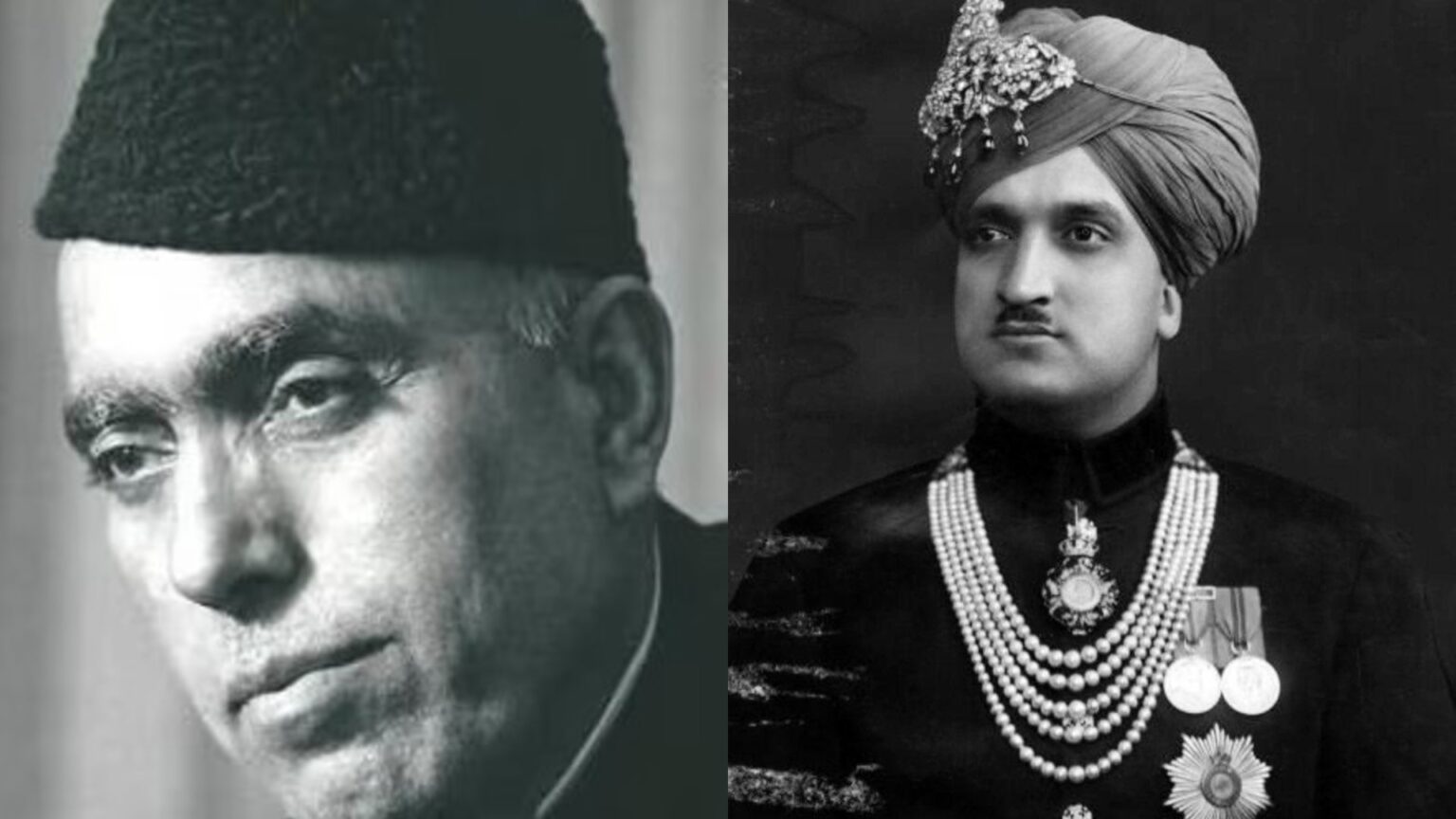
Srinagar, September 23: Nearly eight decades after the events that transformed Jammu and Kashmir’s political future, the names of Maharaja Hari Singh and Sheikh Mohammad Abdullah continue to occupy opposite sides of the region’s political imagination.
The latest reminder came in the Jammu and Kashmir Legislative Assembly on Tuesday, when National Conference MLA Abdul Majeed Larmi demanded the restoration of public holidays associated with Sheikh Abdullah and said that, if that was not done, the government should withdraw the holiday marking Maharaja Hari Singh’s birth anniversary.
The demand triggered protests from BJP legislators, who defended the holiday for Hari Singh and later staged a walkout. PDP legislators also supported the demand for restoring the Sheikh Abdullah holiday and raised the issue of July 13, observed for decades as Martyrs’ Day in J&K.
The exchange came a day before Hari Singh’s birth anniversary, which has been a public holiday in J&K since 2022.
The argument may appear to be about holidays. But beneath it lies a much older question: whose history should be remembered, and through what political lens should Jammu and Kashmir’s past be understood?
That question has followed the region for generations.
A ruler and a political challenger
Born on September 23, 1895, Hari Singh became the last ruling Maharaja of the princely state of Jammu and Kashmir. He succeeded to the throne in the 1920s and ruled through a period of growing political mobilisation, communal tensions and demands for representative government.
His reign also witnessed attempts to define who could claim rights in the state.
The State Subject rules introduced in 1927 restricted access to government employment and ownership of immovable property to recognised state subjects. The measures were subsequently regarded as an important precursor to the later constitutional protections around permanent residents.
But the Maharaja’s rule also faced growing opposition, particularly in Kashmir Valley.
The political awakening that culminated in the 1931 agitation was shaped by a combination of grievances against the autocratic system, demands for political representation and concerns among different communities.
On July 13, 1931, 22 people were killed in firing outside Srinagar Central Jail during protests surrounding the trial of Abdul Qadeer, an event that became a defining moment in Kashmir’s political history.
The uprising helped propel Sheikh Mohammad Abdullah into a central role in Kashmir’s politics.
The young leader would eventually become the most prominent political challenger to Dogra rule in the Valley.
The National Conference traces its political lineage to this period, while Abdullah’s later transformation of the Muslim Conference into the National Conference reflected his effort to give the movement a broader political identity.
From rebellion to Quit Kashmir
The relationship between Hari Singh and Abdullah was never simply a clash between two individuals. It represented a larger confrontation between princely authority and a growing movement demanding political participation.
In 1946, Abdullah launched the Quit Kashmir movement, demanding an end to the Maharaja’s rule. He was arrested and imprisoned.
His imprisonment also became an important point of contention between Hari Singh and Jawaharlal Nehru, who had developed a close political relationship with Abdullah.
By then, the political question confronting Jammu and Kashmir was becoming larger than the Maharaja’s relationship with his subjects.
The British were preparing to leave India. The princely states had to determine their future. India and Pakistan were emerging as two dominions.
And Jammu and Kashmir, strategically located between the two, had a ruler who initially sought to preserve his options.
1947: The decision that changed everything
As independence approached, Hari Singh did not immediately accede to either India or Pakistan.
The uncertainty continued after August 15, 1947.
But the situation changed dramatically in October, amid violence in parts of the state, the Poonch uprising and the tribal invasion from Pakistan’s side.
Faced with the rapidly deteriorating situation, Hari Singh sought military assistance from India.
The Maharaja signed the Instrument of Accession on October 26, 1947. The document was accepted by Governor-General Lord Mountbatten the following day.
The accession became the legal basis for the deployment of Indian troops to defend the state against the invasion.
It also fundamentally altered Hari Singh’s position.
The ruler who had spent months trying to preserve his independence now found his state drawn into the conflict between the two newly independent dominions.
In his letter accompanying the Instrument of Accession, Hari Singh appealed for immediate military assistance and said that he had decided to accede to India in the circumstances created by the invasion.
The accession remains one of the most consequential decisions in the history of Jammu and Kashmir — and one that continues to shape political arguments in the region.
Abdullah’s rise, Hari Singh’s decline
The irony of the period was that the political fortunes of the Maharaja and Sheikh Abdullah were moving in opposite directions.
Hari Singh had been the sovereign. Abdullah had been one of his strongest political challengers.
But after accession, Abdullah emerged as a central figure in the administration of the state.
The Maharaja eventually left Jammu and Kashmir, while Abdullah assumed a leading role in the new political order.
Hari Singh continued as the titular ruler for some years, but the old princely system was gradually dismantled. The monarchy was abolished in 1952, and Hari Singh spent his final years away from Jammu and Kashmir.
He died in Mumbai on April 26, 1961.
Abdullah, meanwhile, would himself go through imprisonment, dismissal and political upheaval, becoming another central figure in the region’s long and complicated political history.
The two men therefore came to represent very different chapters of J&K’s story — but neither disappeared from its politics.
The past returns
For decades, the political symbolism surrounding Hari Singh and Sheikh Abdullah moved in different directions.
In Kashmir, July 13 was remembered as Martyrs’ Day, commemorating those killed in 1931. Sheikh Abdullah’s birth anniversary was also observed as a public holiday.
In 2020, the administration removed July 13 and December 5 from the official holiday calendar. In 2022, September 23 — Hari Singh’s birth anniversary — was declared a public holiday across Jammu and Kashmir.
That change altered the symbolic calendar of the region.
Hari Singh’s birth anniversary moved into official public recognition, while holidays associated with Abdullah and the 1931 political movement disappeared.
The competing interpretations of history consequently acquired a contemporary political dimension.
For those emphasising Hari Singh’s role in the accession of Jammu and Kashmir to India, he is remembered as the ruler whose signature brought the state into the Indian Union at a critical moment.
For those focusing on the political conditions under Dogra rule, his legacy is inseparable from the grievances that produced the 1931 uprising and the subsequent movement for representative government.
Sheikh Abdullah, similarly, carries more than one historical identity: to his supporters, he was the central figure in Kashmir’s political awakening and later played a major role in land reforms and institution-building; to his critics, his political trajectory — including his changing relationship with India and his later demand for greater autonomy — remains deeply contested.
A mirror from one generation to another
That is what makes Tuesday’s Assembly confrontation more than a dispute over government holidays.
The political language has changed, but the underlying contest has familiar echoes.
In the 1930s and 1940s, the struggle was over who should govern Jammu and Kashmir and whose political aspirations should shape its future.
Today, elected representatives are arguing over which figures and events should occupy official public memory.
The contest is no longer over the Maharaja’s throne or Abdullah’s political movement. It is over how their legacies should be represented in a region whose history remains deeply contested.
The irony is that both men, despite their vastly different political positions, remain central to the same historical story.
Hari Singh’s decision to accede to India in October 1947 became a foundational event in India’s understanding of Jammu and Kashmir. Abdullah’s political rise, meanwhile, was rooted in the movement against the Maharaja’s autocratic rule and later became central to the state’s relationship with the Indian Union.
Nearly 80 years later, the two legacies continue to meet — sometimes in history books, sometimes in public holidays, and now, once again, on the floor of the Jammu and Kashmir Assembly.
The dispute over a day off, therefore, is also a dispute over memory.
And in Jammu and Kashmir, memory has rarely been separate from politics.