



As Kashmir’s chinars turn copper and the chill settles over the Valley, the chrysanthemum opens its petals. Rooted in ancient East Asian traditions and guided by the changing rhythm of daylight, the autumn flower offers a reminder that beauty does not belong to spring alone.
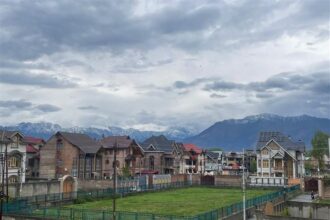
Autumn arrives in Kashmir with a quiet transformation. The chinars turn copper and crimson, leaves loosen their hold on branches, and the mountains begin to lose the lingering warmth of summer. The days grow shorter. The air acquires a sharper edge. Gardens that flourished through the warmer months slowly surrender their colours.
Yet, just as the landscape begins to fade, another flower comes into its own.

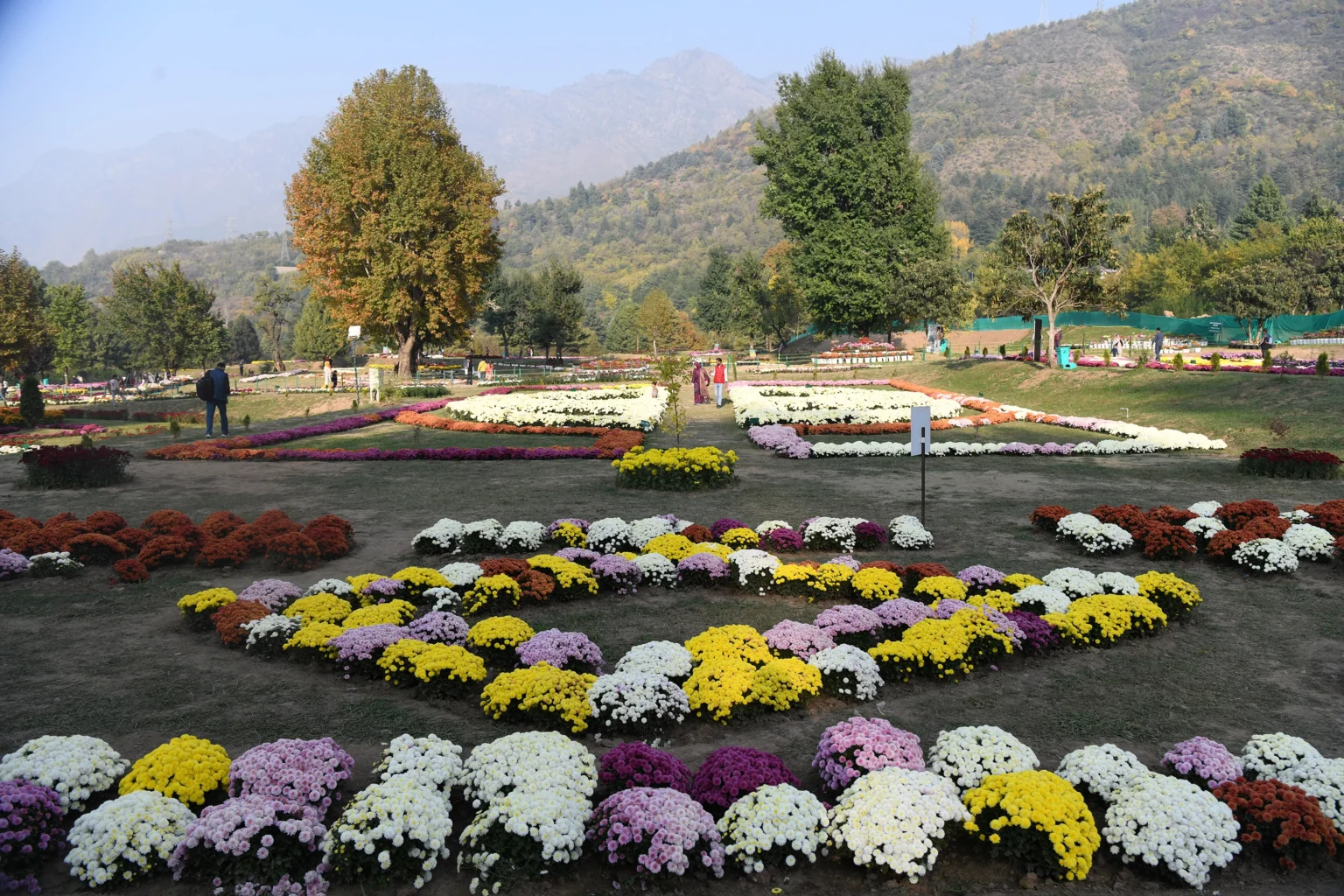
The chrysanthemum opens its petals against the gathering chill, filling flower beds with shades of yellow, white, pink, purple, bronze and red. Some blooms spread like small suns; others gather into rounded cushions, delicate sprays or densely packed globes. Their colours seem almost out of place in a season associated with falling leaves and approaching winter.
But the chrysanthemum belongs here.
It is a flower whose season arrives not with the lengthening days of spring, but with the gradual retreat of daylight. While much of the garden prepares for dormancy, the chrysanthemum begins its own display.
There is something quietly reassuring about this rhythm. The flower does not attempt to hold autumn back. It does not wait for the warmth to return or for the trees to recover their green. It blooms in the season it has been given.
In Kashmir, where autumn is both a spectacle and a passage towards winter, that quality carries its own poetry.
A flower with roots in ancient East Asia
Long before chrysanthemums became familiar features of gardens, parks and flower markets across the world, they were cultivated in East Asia, particularly China, where their history stretches back thousands of years.
The flower gradually acquired significance beyond its ornamental beauty. It was grown for its appearance and, in traditional Chinese practices, also used in teas and other preparations. Its association with autumn, when many other plants begin to wither, helped establish its reputation as a symbol of longevity and vitality.
From China, chrysanthemums travelled to Japan, where they became deeply embedded in the country’s cultural traditions. Known in Japanese as kiku, the flower acquired associations with the imperial household and remains an important emblem in Japanese public and ceremonial life.
Its journey eventually extended to Europe and other parts of the world, where horticulturists developed an enormous range of cultivated varieties.
The chrysanthemum seen today is therefore not a single, uniform flower but part of a long history of cultivation, selection and breeding. Its many forms reflect generations of work by gardeners and plant breeders who shaped its size, colour, petal arrangement and flowering behaviour.
The familiar garden chrysanthemum belongs to a group of plants whose botanical ancestry is rooted in East Asia. Over centuries, cultivation transformed the flower from its earlier forms into the remarkable diversity now found in gardens around the world.
Even its name carries a little history. The word chrysanthemum comes from Greek roots commonly translated as “gold” and “flower”, a fitting description of the golden blooms that helped make the plant famous.
Yet gold is only the beginning of its palette.
A spectrum of colour before winter
Few autumn flowers offer chrysanthemums’ range of colours and shapes.
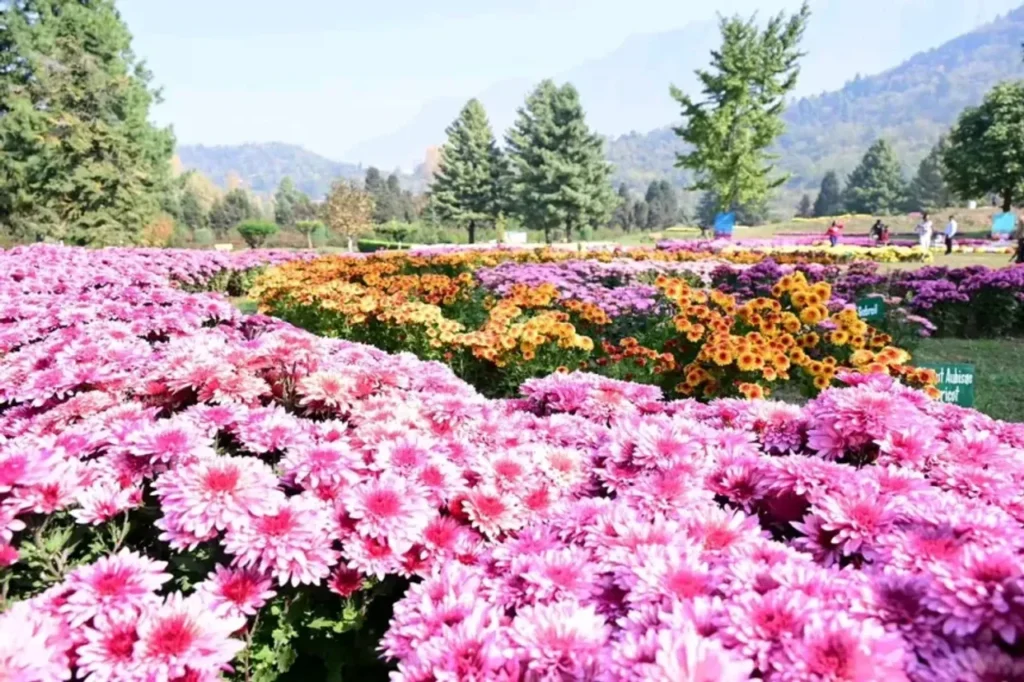
Yellow and gold remain among their most recognisable shades, recalling the warmth of sunlight at a time when the days are growing shorter. White blooms bring a softer contrast, particularly against dark foliage or the earthy colours of autumn. Pink and lavender lend delicacy to the flower beds, while deep reds, purples, bronzes and rusty oranges seem to echo the season’s changing leaves.
Some varieties are pale and understated; others are vivid enough to command attention from a distance.
Their shapes are equally varied. Daisy-like chrysanthemums have an open centre surrounded by a ring of florets. Pompon varieties form compact, rounded heads. Other cultivars develop dense, layered blooms, while spider chrysanthemums produce long, narrow florets that curl or trail outward.
What appears to be a single flower is, botanically, a collection of many small individual flowers, called florets, arranged together in a flower head. The familiar petals are therefore part of a more complex structure than the eye might initially suggest.
This diversity makes chrysanthemums especially suited to landscape gardening. Different varieties can be planted in contrasting bands, grouped by colour or arranged to create patterns across broad flower beds.
For visitors, the result is an autumn landscape that changes with the angle of the light. A bed of yellow blooms may appear almost luminous in the afternoon sun, while darker varieties acquire a richer tone beneath an overcast sky.
In Kashmir, where autumn light can be soft and fleeting, the colours offer a striking contrast to the season’s muted surroundings.
Why does the chrysanthemum bloom as the weather turns cold?
The answer lies not simply in the temperature, but in the relationship between light and darkness.
Many chrysanthemums are known as short-day plants. More precisely, their flowering is triggered by the longer, uninterrupted nights that develop as summer gives way to autumn.
As daylight hours decrease, the plant receives the seasonal signal needed to begin forming flower buds. Depending on the variety and growing conditions, those buds develop over several weeks before opening into full blooms.
The process is known as photoperiodism: the way an organism responds to the relative lengths of day and night.
In chrysanthemums, the length of the dark period is particularly important. The plant effectively responds to the changing seasonal clock, preparing to flower when the days become shorter and the nights longer.
This explains why chrysanthemums are so closely associated with autumn, even though they do not require cold weather itself to bloom.
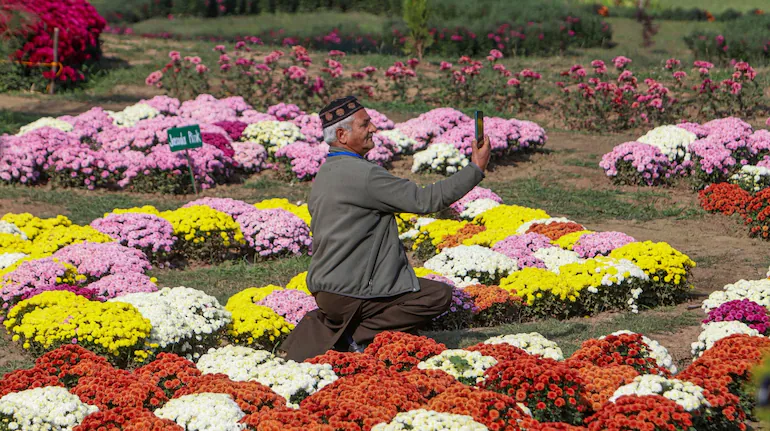
Temperature still matters. Excessive heat can delay flowering in many varieties, while cool conditions may help sustain the autumn display. Some chrysanthemums can withstand light frost, but prolonged freezing temperatures and hard frost can damage the flowers.
In other words, the flower is adapted to a seasonal transition, not invulnerable to winter.
The distinction is important because its apparent relationship with the cold can be misleading. The chrysanthemum does not necessarily bloom because the temperature falls. Rather, shortening days help initiate flowering, while temperature and other growing conditions influence how well the buds develop and how long the flowers last.
Its timing is part of a finely tuned response to the changing environment.
The plant does not read autumn as a signal to abandon flowering. Under the right conditions, it reads it as the moment to begin.
Endurance without the promise of permanence
It is tempting to see the chrysanthemum as a symbol of resilience. But the flower’s endurance is not a story of defying every hardship.
It has limits. Severe frost can damage its blooms. Waterlogged soil and unsuitable growing conditions can weaken the plant. Different varieties respond differently to cold, and their flowering periods vary.
Its resilience lies elsewhere: in its ability to flourish within a particular window of the year, when other familiar garden flowers have passed their prime.
That distinction gives the chrysanthemum’s seasonal appearance a quieter meaning.
Endurance is not always the ability to remain unchanged. Sometimes it is the capacity to respond to changing conditions, to recognise the season and to make use of the time available.
The chrysanthemum does not flower throughout the year in its natural seasonal cycle. Nor does it remain untouched by the weather. It follows the conditions to which it has adapted, producing its blooms when the seasonal signals are right.
Its beauty is therefore inseparable from timing.
In a world that often associates growth with constant expansion and success with perpetual visibility, the chrysanthemum offers a different rhythm. Its moment arrives after the long brightness of summer, when daylight is withdrawing and the garden is beginning to quieten.
There is no triumphal defiance in this. Only a patient unfolding.
The flower opens, displays its colours and, eventually, gives way to the season that follows.
Perhaps that is what makes its autumn presence so affecting. Its beauty is not a denial of change, but a part of it.
More than a flower in the garden
Across cultures, chrysanthemums have acquired meanings that extend beyond their appearance.
In China, they have long been associated with longevity and vitality. In Japan, their connections with the imperial tradition have given them a distinctive place in the country’s cultural imagination.
In other parts of the world, chrysanthemums are used in celebrations, floral arrangements and commemorative settings. Their symbolism varies according to local traditions, and their meanings are not universal.
Yet their seasonal character remains central to their appeal.
They arrive when the garden is changing, offering a vivid reminder that the end of one season can also be the beginning of another kind of beauty.
This association is particularly striking in places where autumn is experienced as a pronounced transition. In Kashmir, the change is visible across the landscape: the chinars shed their leaves, the air grows colder and the mountains begin their gradual passage towards winter.
The chrysanthemum brings colour to this interval.
It does not replace the chinar or compete with the Valley’s celebrated spring blooms. It offers a different experience of the same landscape, one shaped by shorter days, fading leaves and the approach of cold weather.
And unlike a fleeting burst of colour, its flowering period can extend across several weeks, depending on the cultivar and the conditions in which it grows.
For gardeners and visitors alike, this creates an opportunity to experience autumn not merely as the disappearance of summer, but as a season with its own floral identity.
Bagh-e-Gul-e-Dawood: giving autumn a garden of its own
That idea is finding a new expression in Srinagar with the opening of Bagh-e-Gul-e-Dawood, a chrysanthemum-themed garden developed within the Nehru Memorial Botanical Garden.
The garden, created by the Department of Floriculture, Gardens and Parks, Kashmir, has around 3.5 lakh flowering plants and was developed at a reported cost of ₹1.869 crore.
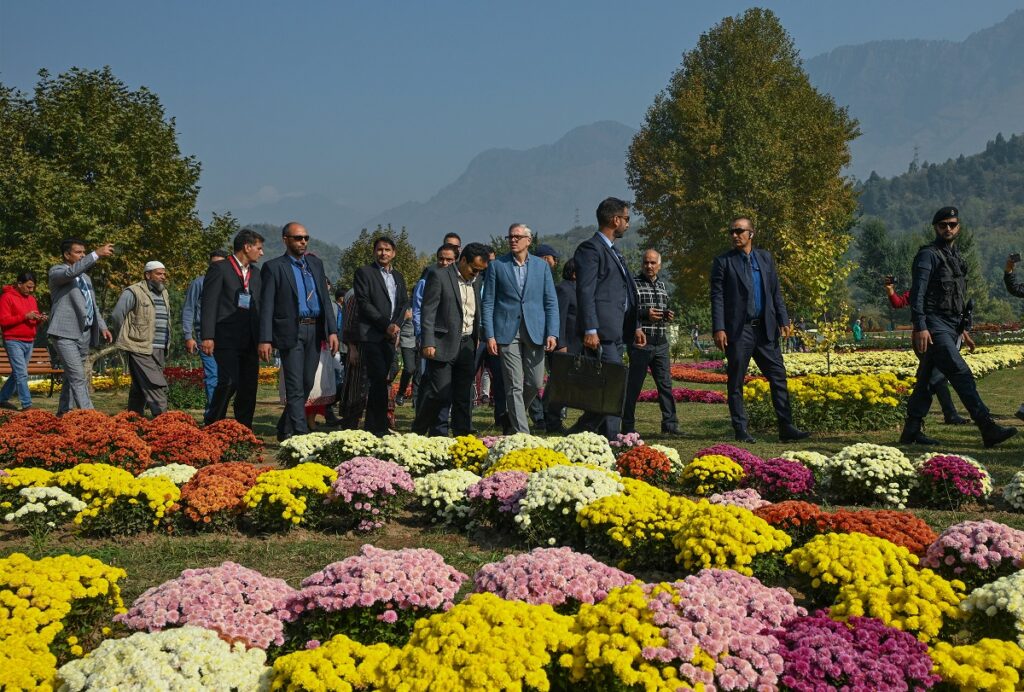
Its floral displays, expanded flower beds, water features, pergolas and visitor facilities are intended to make the garden an attraction during the autumn season.
The name Bagh-e-Gul-e-Dawood refers to the garden of chrysanthemums, known locally as Gul-e-Dawood. The name gives the flower a distinctly regional identity, even as its botanical history connects Kashmir to a much wider world of horticulture.
Director Floriculture, Gardens and Parks, Kashmir, Mathoora Masoom, has described the project as an effort to give autumn an attraction comparable to the Valley’s famous Tulip Garden.
“This is our dream project, and we want the importance and popularity of our Chrysanthemum Garden to be exactly the same as our Tulip Garden. We do not want any season of Kashmir to be dull. Spring will be associated with tulips and autumn with chrysanthemums,” she said on October 22.
The comparison is significant.
For years, Kashmir’s tulip season has provided a recognisable beginning to the Valley’s spring tourism calendar. Its broad, colourful displays draw visitors to Srinagar at a time when the landscape is emerging from winter.
Autumn has its own visual appeal, particularly in the changing chinars, but the chrysanthemum garden offers a more concentrated floral attraction.
The two gardens belong to different seasons and different moods. Tulips announce the return of colour after winter. Chrysanthemums extend that colour into the period when summer has passed and winter is approaching.
The new garden also features trees such as chinar, maple and ginkgo, adding different autumn hues to the landscape.
Masoom said the chrysanthemums could remain in bloom until December 5 or 6, depending on the weather.
The length of the display will ultimately depend on growing conditions and the behaviour of the varieties planted. But the intention is clear: to give visitors another reason to experience Kashmir beyond the spring tourism rush.
For the local tourism sector, such seasonal attractions may also help broaden the calendar of visitor experiences, drawing attention to the Valley’s changing landscapes throughout the year rather than concentrating it around a single season.
The garden’s longer-term significance will depend on its upkeep, the quality of its floral displays and its ability to attract visitors in successive years. For now, it introduces a new way of experiencing Srinagar’s autumn.
A different way to see Kashmir
Kashmir’s beauty is often described through its extremes: the lush green of summer, the flowers of spring, the golden chinars of autumn and the snow-covered mountains of winter.
Each season has its familiar image. Yet the transitions between them can be just as revealing.
Autumn is not simply a prelude to winter. It has its own colours, its own light and its own pace. The falling leaves are not the only story unfolding in the gardens and parks of the Valley.
The chrysanthemum makes that visible.
Its flowers emerge as the days shorten, adding colour to a landscape preparing for cold. Their presence does not erase the signs of seasonal change; it sits alongside them.
The chinar can shed its leaves while the chrysanthemum opens its blooms. The mountains can grow colder while the garden remains full of colour. These processes are not contradictions. They are different expressions of the same season.
In that sense, Bagh-e-Gul-e-Dawood offers more than another place for photographs. It creates an opportunity to notice a part of Kashmir’s natural calendar that has received less attention than the Valley’s spring spectacle.
The garden’s success will be measured partly in visitor numbers, but also in whether it encourages people to see autumn as a destination in its own right.
For residents, it offers a new seasonal space within Srinagar. For tourists, it adds another dimension to a landscape often encountered through its better-known attractions.
And for anyone who pauses among the flowers, it offers a reminder that beauty need not arrive at the beginning of a cycle or last indefinitely to matter.
When the season changes, the flower opens
As autumn advances, the chrysanthemum’s display will eventually diminish. The flowers will fade, temperatures will fall further and the garden will enter another phase of its yearly cycle.
There is no escaping that progression. The same seasonal rhythm that brings the flowers into bloom will, in time, bring their display to an end.
But for the weeks in between, the garden offers a different view of the approaching cold.
Against the deepening colours of autumn, the chrysanthemums stand in yellow, white, pink, purple and bronze. Their blooms make no promise that winter will be mild or that the landscape will remain colourful.
They simply flower when their season arrives.
Perhaps that is the quiet lesson of the chrysanthemum: endurance does not always mean resisting change. It can mean finding the conditions in which one can flourish, even as the world around one moves towards a different season.
In Kashmir, where the beauty of autumn is inseparable from the knowledge that winter is coming, the flower seems particularly at home.
It does not ask the days to grow longer.
It blooms in the shortening light.