



Srinagar: In a Kashmiri household, hospitality is measured by more than the food served. The utensils in which a guest is welcomed carry their own significance, often reflecting the respect accorded to the guest and the importance of the occasion. At the heart of this tradition is Traam — copperware that has remained an inseparable part of Kashmiri life across generations.
Despite changing lifestyles, modern crockery and contemporary dining habits, copper utensils continue to occupy a special place in Kashmiri homes, whether used for cooking and serving food or preserved as decorative pieces. For many families, no festival feels complete without them, and no traditional feast quite carries the same meaning without copperware.
Carrying a piece of home abroad

For Henna Mohiuddin, a Kashmiri woman settled in Dubai, the attachment to copperware was strong enough to make it one of the first things she packed when moving abroad.
She recalls taking a large suitcase specifically for her traditional copper utensils, even before completing the packing of her clothes.
“It’s obvious that Kashmiris and Traam share a deep connection. Whether it is Eid or another family occasion, we continue to use these utensils for serving food. Without them, a festival simply doesn’t feel like a festival,” she said.
Her attachment to the tradition continues even after settling abroad. She said she regularly asks her mother to send her new copper utensils whenever she comes across something new in the market.
“These are not just utensils; they are our heritage and tradition. That is why copperware continues to be gifted to brides even today. The world may be moving towards modern lifestyles, but some things never lose their place in our lives. Traam is one of them,” she said.
Benish Khan, an engineer based in Mohali, Punjab, recalled that when her friends first saw the utensils, they mistook them for silverware.
“Their way of asking was quite funny. They said, ‘Oh, royal Kashmiris, do you eat in chandi?’ I laughed for a while before explaining that they were actually copper utensils,” she said.
“The silvery coating, known as kaleai in Kashmiri, is made of tin and is applied to prevent food from reacting with the copper and developing a sour taste,” an artisan from downtown said.
Earlier, people from outside Kashmir would wander from one lane to another looking for kaleai services. Today, however, the polishing is mostly done near copperware shops.
Wazwan and the survival of the craft
For those associated with the trade, the continued popularity of copperware is closely linked to Kashmir’s culinary traditions, particularly Wazwan.
Afaaq Ahmad, a copperware seller from Srinagar’s Zaina Kadal, said the traditional multi-course feast has played an important role in keeping the craft alive across generations.
“Wazwan is one of the main reasons this craft has survived through generations. People cannot imagine Wazwan without the traditional dishes being prepared in copper utensils. The two are inseparable,” he said.
He said that although modern dinner sets have found their way into Kashmiri households, copperware has retained its appeal and cultural value.
“We have seen people buying new and modern dinner sets, but copper utensils have never lost their appeal or importance. They continue to hold a special place in Kashmiri homes. They are forever for Kashmiris,” he said.
A tradition rooted in history
Copper craftsmanship in Kashmir has a history stretching back several centuries. The tradition is commonly associated with the cultural exchanges that brought Persian and Central Asian influences into the Valley, particularly during the medieval period.
The arrival of Mir Sayyid Ali Hamadani, popularly known as Shah-e-Hamadan, is frequently linked to the development of several Kashmiri crafts, including metalwork. The craft received considerable patronage during the reign of Sultan Zain-ul-Abidin, popularly remembered as Budshah, in the 15th century.
Over time, copperworking developed into an established occupation in Srinagar, particularly in the old city, where generations of artisans refined the techniques of shaping, hammering and engraving metal.
The craft became associated with neighbourhoods such as Zainakadal, Rajouri Kadal and Nowhatta, where the sound of hammers striking copper sheets became part of the everyday character of downtown Srinagar.
Copper, locally known as Traam, was transformed into objects of everyday use as well as elaborate pieces of craftsmanship. What began as a functional household tradition gradually acquired artistic and cultural significance.
More than utensils
A traditional Kashmiri home has its own vocabulary of copperware, with every object serving a particular purpose.
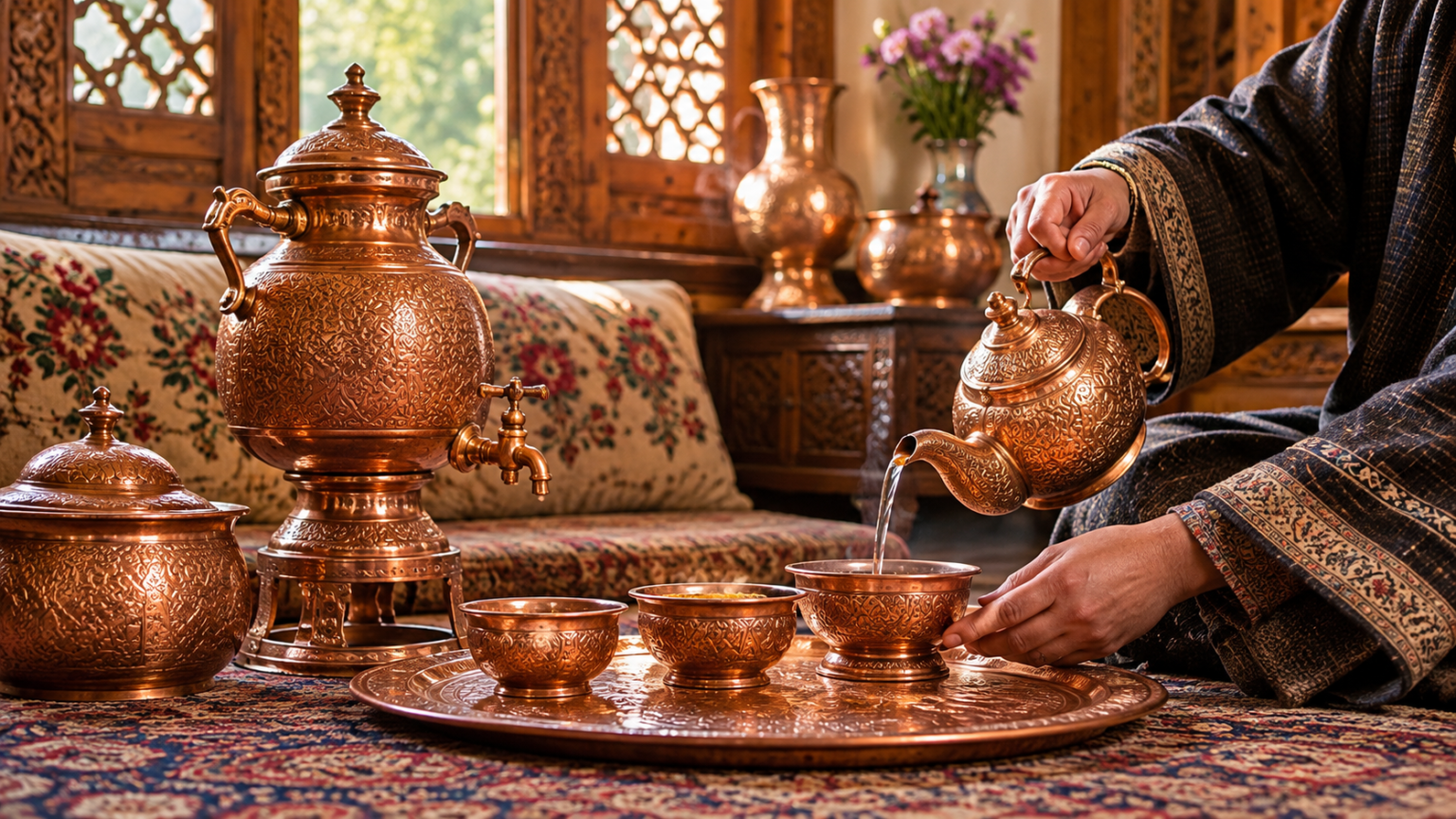
The Traami, a large, round copper platter, remains among the most recognisable symbols of Kashmiri dining. Traditionally, four people sit around one platter to share a meal, making it an important part of the Valley’s communal eating culture.
The Samovar, another iconic copper creation, occupies a special place in Kashmiri hospitality. Used for preparing and serving traditional beverages such as Kahwa and Noon Chai, it is often placed prominently in drawing rooms and dining spaces, particularly when guests arrive.
The Degchi and Handi are used for cooking, while the Toor serves as a bowl for different food items. Large serving spoons, including the locally used Qashwi, and other copper accessories complete the traditional dining arrangement.
The Tash-e-Naari, comprising a basin and pitcher, is another important element of traditional hospitality. It was traditionally used to offer guests water for washing their hands before and after meals, particularly during elaborate feasts.
Even objects that are no longer used regularly have retained their cultural importance. The Chonchi, traditional spoons, bowls, trays and decorative vessels continue to find space in cupboards, display shelves and specially arranged corners of Kashmiri homes.
In many households, these objects are not purchased simply to fulfil a domestic requirement. They are acquired with the intention of preserving a family tradition.
The language of Kashmiri hospitality
Perhaps nowhere is the importance of copperware more visible than during weddings and the traditional Wazwan.
Wazwan, Kashmir’s elaborate multi-course ceremonial feast, is closely associated with the Traami. Groups of four guests traditionally share a platter, creating a dining arrangement that reflects the collective nature of Kashmiri food culture.
The presentation of food, the arrangement of serving vessels and the use of traditional copperware are all part of the experience.
Copper items also occupy an important place in wedding preparations and gift-giving customs. Traditional utensils, including Samovars and dining sets, are often included in a bride’s trousseau, making them possessions that accompany her into a new household.
Some families preserve these items for decades, passing them from one generation to another. A Samovar or a set of copper utensils inherited from parents or grandparents may carry memories and emotional value that cannot be measured by its market price.
This explains why copperware continues to be purchased even by families whose kitchens have largely adopted modern appliances and contemporary crockery.
Changing homes, enduring traditions
Kashmiri homes have changed considerably over the years. Modern furniture, imported crockery, modular kitchens and contemporary interior designs have altered domestic spaces.
Yet, unlike many traditional household objects that have gradually disappeared, copperware has adapted to these changes.
In some homes, engraved copper plates and Samovars are displayed alongside modern decorative pieces. In others, traditional vessels are arranged in glass cabinets or placed on shelves as reminders of family heritage.
Restaurants have also embraced the appeal of copperware. Several establishments serving Kashmiri cuisine use traditional Samovars, copper platters and serving bowls to create an atmosphere associated with the Valley’s cultural identity.
For visitors, these objects offer a visual introduction to Kashmir’s culinary traditions. For locals, they bring familiarity to dining experiences that might otherwise feel disconnected from traditional homes.
The continued presence of copperware in restaurants and contemporary interiors suggests that its relevance is no longer limited to its original domestic purpose. It has also become an important part of how Kashmiri culture is presented and experienced.
The hands behind the craft
Behind every engraved copper vessel is a chain of specialised craftsmanship that has been sustained through generations.
The process begins with the copperworker, locally known as the Thanthur, who shapes the metal through heating and repeated hammering. The vessel is then passed through different stages of finishing and ornamentation.
The Naqash creates intricate patterns, often drawing inspiration from flowers, leaves, traditional motifs and calligraphy. Other artisans undertake polishing, finishing and decorative work.
Two traditional techniques are particularly associated with Kashmiri copperware.
Naqashi refers to the intricate engraving and ornamentation that gives copper objects their distinctive appearance. Kaalai, meanwhile, is the traditional process of coating the interior of cooking and food-serving vessels with tin.
The tin coating is important because unlined copper can react with certain foods, particularly acidic preparations. Periodic re-tinning helps maintain the vessels for their intended culinary use.
The finished products are therefore not merely metal containers. They represent hours of skilled labour, knowledge of materials and techniques passed down within artisan families.
Tradition in a changing world
Despite its continued cultural relevance, traditional copper craftsmanship faces the pressures of changing consumer preferences, mechanised production and competition from cheaper alternatives.
Machine-made products can be manufactured faster and often sold at lower prices, while handmade copperware requires considerable time, skill and labour.
For traditional artisans, sustaining the craft also means ensuring that younger generations see a future in the occupation.
Yet the continued demand for engraved copperware, particularly for weddings, gifts, restaurants and decorative purposes, offers the craft avenues beyond its conventional use.
For Kashmiris, however, the value of Traam goes beyond its commercial or decorative appeal.
A copper Samovar brought out when relatives visit, a Traami placed at the centre of a family meal or an old set of utensils preserved by parents carries something that modern crockery cannot easily replace.
Even when Kashmiris move away from the Valley, these objects often move with them. They find a place in homes across the country and overseas, allowing families to retain familiar customs and pass them on to younger generations.
In a world where kitchens and dining habits are increasingly shaped by modern lifestyles, Traam has managed to retain its place in Kashmiri life.
It is at once a household possession, a work of art, a symbol of hospitality and a reminder of a shared cultural past.
For Kashmir, copper is not simply a metal that is hammered into utensils. It is a tradition that continues to bring families together, welcome guests and connect generations.