




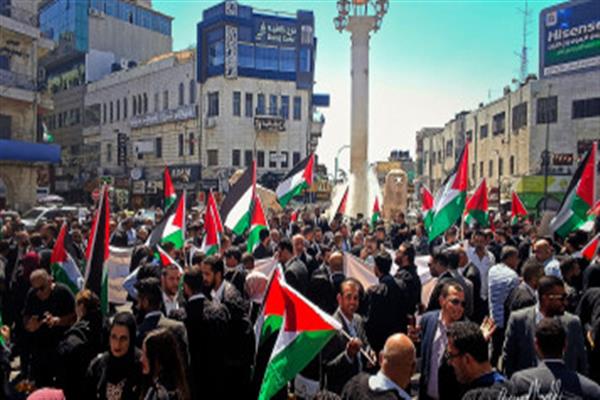
Hundreds of Palestinian lawyers held a street protest in the occupied West Bank against the Palestinian Authority’s “rule by decree”, condemning President Mahmoud Abbas for governing without a parliament.
The new leadership at the Palestinian Bar Association also protested near the office of Prime Minister Mohammad Shtayyeh but police prevented the demonstrators from entering the premises.
All the protestors were wearing black robes and the association’s President Suheil Ashour told AlJazeera that Palestinian Authority President Abbas has gone too far.
"The bar body would stand firm against legislation delivered by presidential decree that curbed Palestinian “rights and freedoms." Our demand is either to stop their implementation now or to cancel” a raft of restrictive laws, said Ashour told AFP at the protest.
“These laws don’t only affect the Bar Association, but also the Palestinian people as a whole. I am here to tell President Abbas that these decrees destroy the judicial system, destroy the ruling authority, and could start a civil war,” Zainab al-Salfity, a lawyer, told Al Jazeera.
The Palestinian leadership remains deeply divided: the movement group Hamas controls Gaza, while Fatah, nominally administers the West Bank through the Palestinian Authority (with Israel still ultimately in control)
Abbas was elected PA president in 2005, following the death of iconic leader Yasser Arafat during which Hamas swept to victory in the 2006 Palestinian legislative elections.
Last year, Abbas led by Fateh announced to hold legislative elections followed by Presidential elections across the Palestinian territories but cancelled citing Israel’s refusal to allow voting in occupied East Jerusalem.
Public demonstrations against Abbas and the Palestinian Authority have been on the rise in the West Bank, notably following the death in Palestinian custody of activist and Abbas critic Nizar Banat last year with Palestinians blaming Abass forces beating him to death.
It should be emphasized that the PA was created by the Oslo Accords to be the organ through which the Palestinians would gradually receive the powers from Israel according to the agreements with the PLO.
Oslo accords was a peace deal signed between Israeli Prime Minister Yitzhak Rabin and Palestinian leader Yasser Arafat in 1993 with U.S. Pres. Bill Clinton shaking hands with Yasser Arafat, leader of the Fateh.
The deal was named after the Norway city Oslo.
Among Palestinians, supporters of the Oslo Accords reasoned it was a compromise that could lead to peace. Fatah, the largest faction in the PLO at the time, supported Oslo as Yasser was tthe then chairman.
But other political parties outside of the PLO, such as Hamas and Islamic Jihad, opposed the Accords and warned that a two-state solution would betray the rights of Palestinian refugees to return to the land taken from them during the 1948 Nakba.
The final-status of the negotiations between Palestinian and Israeli leaders have repeatedly failed.
Recently, PA President announced to hold fresh peace talks with Israel.