




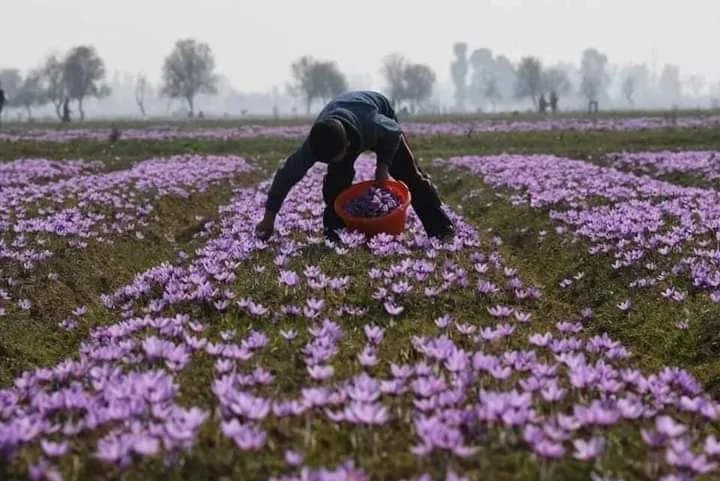
SRINAGAR, August 14: Saffron growers in south Kashmir have urged the authorities to strengthen measures to conserve saffron corms and prevent their unauthorised movement outside Jammu and Kashmir, warning that the continued shortage of quality planting material could threaten the future of the Valley’s traditional “red gold” crop.
The growers have also welcomed the Agriculture Department’s plan to establish Saffron Seed Multiplication Nurseries in Pampore, saying dedicated facilities for multiplying healthy corms could provide farmers with a reliable source of quality planting material and reduce pressure on existing stocks.
“Saffron is not merely an agricultural commodity for us; it is our heritage and livelihood. If quality corms leave Kashmir illegally, there will be less planting material available for local farmers in the coming years,” said Mohammad Ashraf, a saffron grower from Pampore.
More Read

Read more: Kashmir’s Prized Crop Faces ‘Heritage Erosion’ as Imitations Flourish in Northeast
Growers said the shortage of healthy corms was already affecting cultivation and called for a structured system under which planting material could be produced locally, certified and supplied to farmers at reasonable rates.
“Farmers should not be forced to depend on whatever planting material is available in the market. The government needs to ensure that healthy and quality corms are produced locally and made available to growers at reasonable rates,” another grower said.
Nurseries seen as key to conserving crop
Farmers said the proposed seed multiplication nurseries could address one of the major constraints facing the sector by multiplying quality corms and creating a dependable source of planting material ahead of the sowing season.
They urged the government to expand such facilities to other major saffron-growing areas, arguing that increased local production of quality corms would help rejuvenate declining fields while reducing dependence on existing stocks.
Agriculture officials said restrictions had already been imposed on the transportation and export of saffron corms outside Kashmir, and warned that violations could attract action under the Saffron Act, 2007 and Seed Act, 1966.
“Restricting the transportation of saffron corms outside the Valley is an important step towards conserving the planting material available in Kashmir,” an official said.
The official added that the department was also working towards establishing Saffron Seed Multiplication Nurseries in Pampore, which would help multiply quality corms and make them available to local growers.
Farmers, however, have called for stronger enforcement, including inspections at roads, markets and other vulnerable points, particularly with the extraction season approaching. They have also sought registration and documentation of corm dealers, regular field-level verification and strict action against unauthorised transportation.
Production remains uneven
The concerns come as Kashmir’s saffron sector continues to face challenges linked to weather variability, fluctuations in productivity, availability of quality planting material and the need for field rejuvenation.
Government data presented in the Assembly showed saffron production at 17.33 metric tonnes in 2021, which fell to 14.87 MT in 2022 before marginally increasing to 14.94 MT in 2023.
The total cultivated area remained around 3,715 hectares, while productivity varied from year to year.
Growers said the figures underline the need for sustained investment in scientific cultivation, irrigation, field rejuvenation and, above all, quality planting material.
They said government interventions had helped improve some saffron fields, but warned that such gains could be undermined if healthy corms continued to be removed from the Valley.
“If immediate steps are not taken, there may be no traces of this crop in the coming years,” a grower said.
Saffron, primarily cultivated in Pampore and adjoining areas of Pulwama district, is valued for its distinctive aroma, colour and flavour and is also associated with medicinal uses. For growers, however, safeguarding its future increasingly depends on protecting the basic planting material from which the crop is regenerated.
Farmers have urged the Agriculture Department to establish a comprehensive mechanism for multiplication, certification and distribution of quality corms before the planting season, saying that conserving saffron corms today is essential to keeping Kashmir’s centuries-old saffron fields productive in the future.