



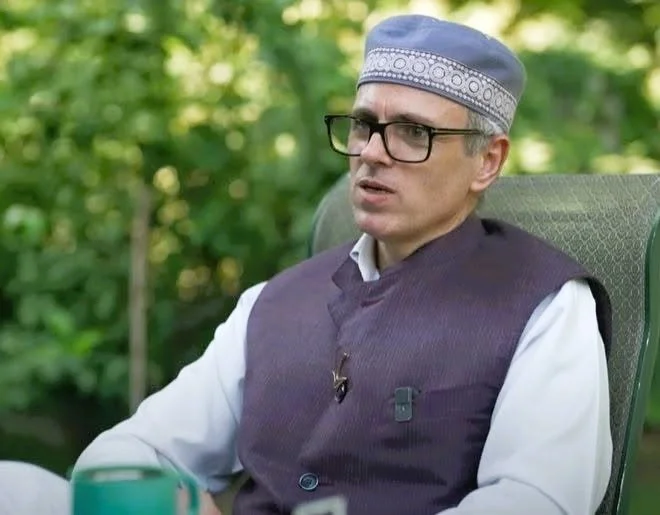
NEW DELHI, Aug 10: Jammu and Kashmir Chief Minister Omar Abdullah has said his constructive approach towards the Centre over restoration of statehood has cost him a “huge amount” of political capital, as growing frustration in the region increasingly reflects on his own political standing.
In an interview with journalist Karan Thapar for The Wire, Abdullah said he had deliberately placed his political credibility at stake by maintaining a cooperative relationship with the Union government in the expectation that statehood would be restored.
“I put a huge amount of my own political credibility at stake for this. I know for a fact that I’ve eroded a large part of it,” Abdullah said.
More Read

Acknowledging the anger and disappointment over the continued delay, the Chief Minister said the political fallout was not directed solely at the Centre and that he continued to bear the consequences of a decision over which he had no control.
“I will pay the price for sins that are not mine, and again, I will carry that cross because it’s mine to bear,” he said.
Abdullah said his initial strategy of building a constructive working relationship with the Union government was based on the belief that it could help secure an early restoration of statehood. However, he acknowledged that the approach had severely affected his credibility among his constituents.
He sharply criticised the present constitutional arrangement, describing Jammu and Kashmir as a Union Territory with an Assembly as an “abomination”.
“There is no worse form of government than a Union territory with an Assembly. Please, by all means, have Union territories, but don’t give them assemblies,” he said.
Abdullah pointed to what he described as the limited authority of the elected government, saying key institutions, including the Jammu and Kashmir Power Development Corporation and Sher-i-Kashmir Institute of Medical Sciences, remain under the authority of the Lieutenant Governor.
He also said his Cabinet does not have the power to choose even its own administrative secretaries or appoint an Advocate General, underscoring what he described as the structural limitations of the present arrangement.
‘Finishing line’ keeps shifting
Questioning the Centre’s repeated assurance that statehood would be restored at an “appropriate time”, Abdullah said the absence of a defined timeline had effectively turned the process into a moving target.
“It’s like running a marathon. Instead of completing it in 42 km, every time you reach near the finishing line, they keep shifting it,” he said.
The Chief Minister called for clear and measurable parameters from the Union government, arguing that the elected administration should know precisely what it needs to achieve for statehood to be restored.
Abdullah also rejected suggestions that statehood could remain contingent on the complete eradication of militancy, arguing that his elected government has no control over the security apparatus in Jammu and Kashmir.
“The problem with this argument is that you’re effectively punishing a government that has no role in this,” he said.
“Militancy does not exist in Jammu and Kashmir because there’s an elected government. In fact, we have absolutely nothing to do with the security mechanism that is in place in J-K right now,” he added.
Abdullah further argued that linking statehood to the end of Pakistan-sponsored terrorism would effectively place the decision outside the control of the elected government.
“If Pakistan stops sponsoring terror, you will restore statehood — effectively transferring the decision from our capital to Islamabad,” he said.
Says statehood must precede Article 370 restoration
Responding to criticism that he has softened his position on Article 370, Abdullah said restoration of statehood was a necessary legal and constitutional step before any discussion on the division of powers between the Union and a state could take place.
“Article 370 was basically the division of powers between the Union government and the state government. How can you have a state list when you are not a state? Statehood has to come before (Article) 370 can be restored,” he said.
‘Modi Ka Wada’ carries PM’s personal credibility
Abdullah also invoked Prime Minister Narendra Modi’s repeated commitment to restore statehood, saying the assurance had been presented not merely as a routine political promise but as a personal commitment.
“The prime minister put his personal credibility behind it. He said the restoration of statehood is not just any other promise; it’s a ‘Modi Ka Wada’,” Abdullah said.
He said the commitment therefore carried greater weight and that the continued delay raised questions about the accountability of the Union government.
Abdullah urged the Modi government to honour commitments made to Parliament, the judiciary and the people of Jammu and Kashmir.
Despite the political cost of his approach, the Chief Minister said his government would continue to press for restoration of statehood through political dialogue as well as protests and demonstrations, including in the national capital.