



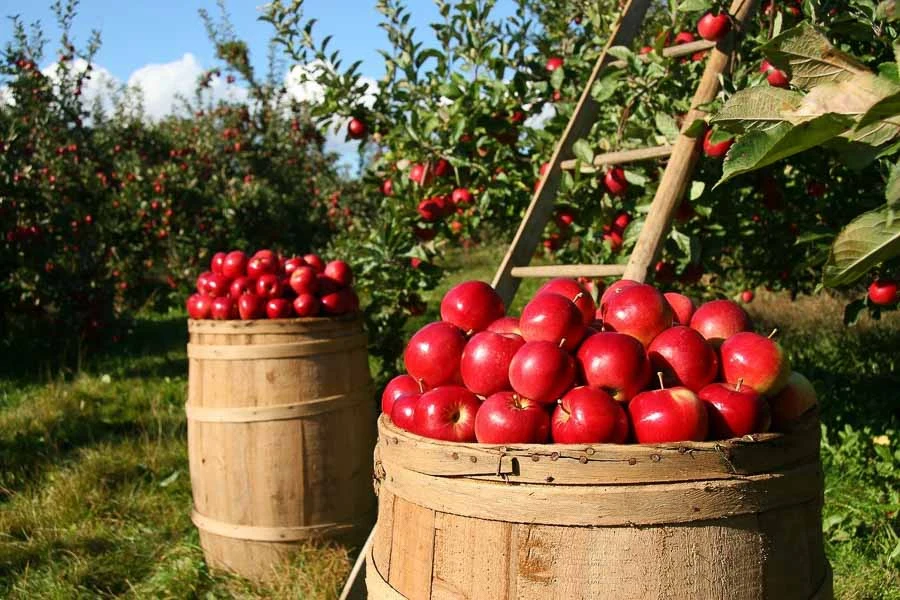
Srinagar, Sep 10: Kashmir’s apple orchards are undergoing a significant transformation, with farmers increasingly replacing traditional varieties with high-density plantations as they look for higher returns, lower cultivation costs and greater productivity.
The shift is being driven by both changing economics and the growing challenges faced by conventional orchards, including unpredictable weather, hailstorms, pest attacks and difficulties in transportation and marketing.
Since the High-Density Plantation (HDP) scheme was launched in 2016–17, the Horticulture Department has brought 818.51 hectares of land under high-density apple plantations across Kashmir, benefiting 2,083 farmers, according to departmental data up to August 31, 2025.

The transition is particularly visible in south Kashmir, one of the Valley’s major apple-growing regions, where growers are increasingly uprooting older trees and replacing them with high-density plants.
Ashiq Hussain, an apple grower from Bijbehara in south Kashmir, said the economics of cultivation was behind his decision to make the switch.
“We are uprooting traditional variety trees and planting high-density because it generates good income and the investment is less,” he said.
The move comes after several difficult years for Kashmir’s apple industry. Since 2019, growers have faced the Covid-19 lockdown, transportation problems, untimely snowfall, changing climatic conditions, hailstorms and pest attacks, adding to the uncertainty surrounding traditional apple cultivation.
For many growers, the newer plantation system offers a way to improve productivity while reducing the time and resources required to maintain orchards.
“High density is new technology. We were investing too much in Delicious and other varieties, but the output was less and they were not yielding good income,” said Sayer Ahmad, an apple grower from south Kashmir.
The difference in productivity is one of the major attractions of the new system. According to figures cited by the Horticulture Department, high-density orchards can produce around 50 to 70 metric tonnes of apples per hectare, compared with about 10 to 12 metric tonnes from conventional orchards.
The government has also promoted the transition through financial assistance, including a 50 per cent subsidy for eligible orchardists.
Umer Veeri, an apple orchard expert from Anantnag, said the adoption of high-density plantations was increasing among growers.
“People are switching to high-density plants. Very few pesticides are used,” he said.
The government has described high-density plantation as a key part of efforts to modernise Jammu and Kashmir’s horticulture sector and improve productivity.
Dr Farhat Shaheen, a professor at SKUAST-Kashmir’s Institute of Business & Policy Research, said high-density plantation was a flagship programme of the J&K government and that production from such orchards was comparable with levels achieved in European countries.
But the rapid shift is also changing the character of Kashmir’s traditional apple landscape.
For decades, varieties such as Delicious were central to the Valley’s apple economy. Their replacement by newer, high-density plantations reflects the growing pressure on farmers to prioritise productivity and income over traditional cultivation practices.
The change is therefore not merely about replacing one type of tree with another. It marks a broader shift in how Kashmir’s apple growers view their orchards — from traditional plantations shaped by generations of cultivation to more intensive systems designed around productivity, efficiency and commercial returns.
As more growers make the transition, Kashmir’s apple landscape is gradually acquiring a new identity — one where high-density plantations are becoming the symbol of a changing horticulture economy, even as traditional varieties struggle to retain their place.