




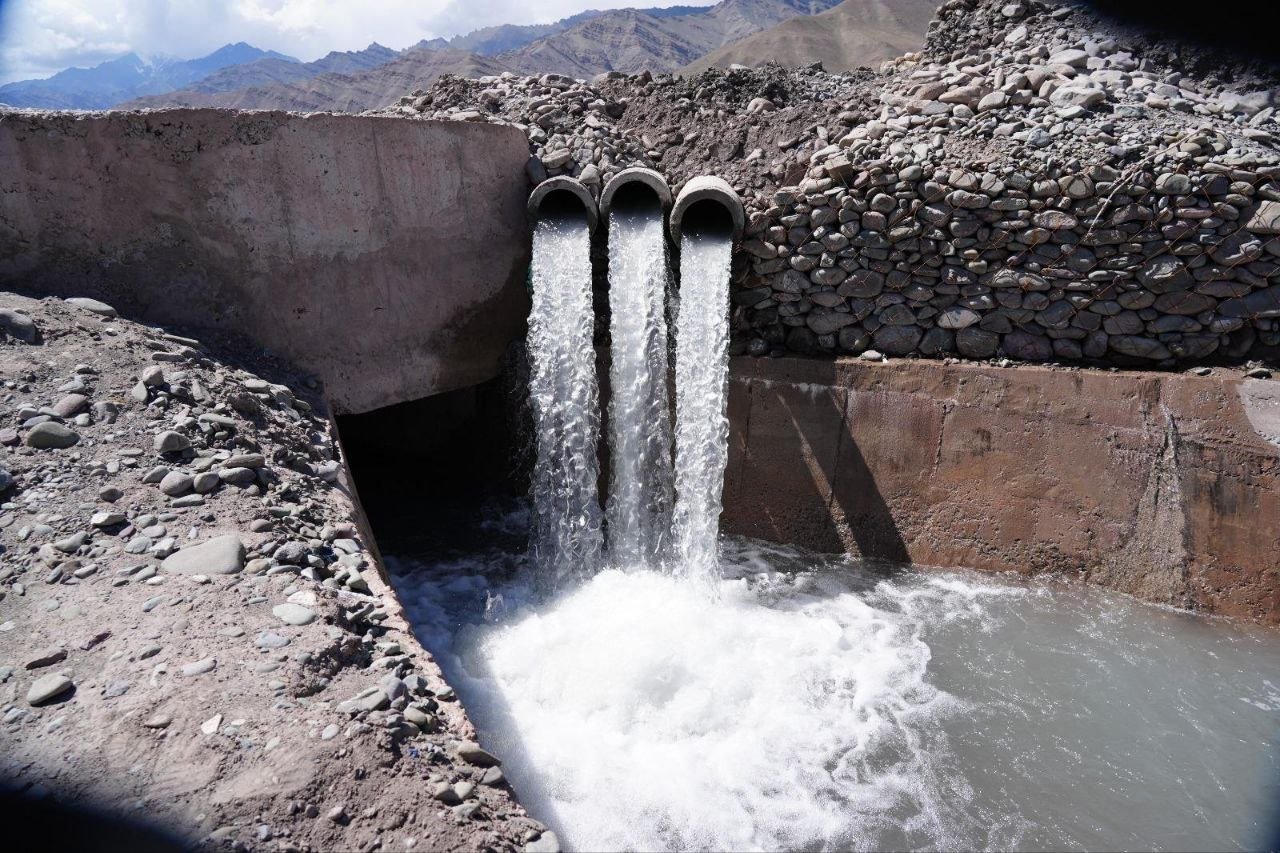
LEH, AUGUST 21: The Ladakh administration has begun diverting nearly 90 million litres of glacier-melt water every day from Stok village Nallah in Leh to the Igoo-Phey Irrigation Canal, in a major push to strengthen agricultural and water security in the cold-desert region.
The diversion is expected to benefit nearly 12 villages and augment irrigation for more than 1,000 acres of land that had remained largely barren due to inadequate water supply. The water was earlier flowing downstream into the Indus River without being utilised for irrigation.
The administration said the intervention was carried out through simple earthwork and did not require any capital expenditure.

“This comes as a step toward transforming the region’s agricultural productivity and realising the vision of a green, water-secure and self-sustaining Ladakh,” an official spokesperson said.
The Stok Nallah, fed by the Stok Kangri Glacier near Leh, was identified as a major source of untapped glacial runoff. Following directions issued by Lieutenant Governor VK Saxena on August 14, the Irrigation and Flood Control Department created two trenches using a JCB to divert excess water from the main channel into the Igoo-Phey Canal.
Officials assessed the discharge from the Stok Nallah at around 36.60 cusecs. One cusec is equivalent to 28.32 litres per second, translating to approximately 90 million litres over 24 hours.
Of the available flow, around 26 cusecs have initially been diverted towards the canal system—19 cusecs towards Igoo village upstream and seven cusecs towards Phey village downstream. Planning is underway to utilise the remaining 10 cusecs.
“By intercepting and utilising this daily flow of 90 million litres, the administration has proven the feasibility of large-scale water diversion to bolster the region’s cold-desert agriculture,” the official said.
The intervention is expected to increase the flow in the Igoo-Phey Canal from its current level of around 50 cusecs to nearly 80 cusecs, significantly improving its irrigation capacity.
The 43-km-long Igoo-Phey Canal was constructed between 1979 and 2005. Around 200 metres of the canal was built underground so that water from the Stok Nallah could pass over it without disrupting the canal’s flow.
Despite the availability of glacier water when the canal project was conceived nearly five decades ago, the potential of the source was never fully harnessed. The canal subsequently faced recurring water shortages and was eventually rendered defunct.
The latest diversion seeks to address that long-standing mismatch: large volumes of glacier and snowmelt water flowing downstream, alongside extensive agricultural land struggling with chronic irrigation shortages.
During visits to villages across Ladakh, the Lieutenant Governor identified locations where substantial quantities of glacier water were flowing into the Indus and pushed for their diversion towards productive agricultural use.
The Stok Nallah project is among the first such interventions aimed at converting previously untapped glacial runoff into a dependable irrigation resource, potentially expanding agricultural activity and strengthening rural livelihoods across the region.