




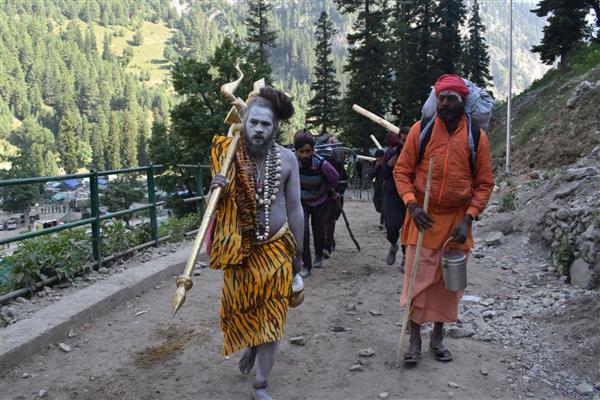
Sonamarg/Pahalgam: Director General of the Border Roads Organisation (BRO) Lt Gen Raghu Srinivasan said on Tuesday that pilgrims planning to visit Amarnath cave shrine would experience ‘improved tracks’ this year as the roads have been widened with railing and sidewalls at vulnerable locations, especially in the areas prone to shooting stones for the safety of the devotees.
“I am back from the Baltal (base camp). Last year, we were assigned with the task of widening the track which was important for the safety of the devotees. We have completed the widening work and also covered the surface with blocks and attended curves and slopes,” the DG BRO told reporters on the sidelines of a tunnel breakthrough function in Rajouri.
He said the BRO has also completed the most important work of laying roadside railing and sidewalls at vulnerable locations especially in the areas prone to shooting stones from the hillocks to keep the pilgrims safe. Drainage was also completed on the tracks for better outlet of rain water, Lt Gen Srinivasan said.

The DG said it is heartening to note that the BRO has become ‘agency of choice’ for construction of infrastructure, including roads in strategic, sensitive and inaccessible areas where the work is only possible for six months due to weather vagaries.
“We are considering ourselves fortunate by getting such projects. We are presently working on Nimu-Padam-Darcha road (in Ladakh) which will connect Manali to Leh through Darcha and Nimmu on Srinagar-Kargil–Leh highway, providing a third axis (apart from Manali-Leh and Srinagar-Leh which connects Ladakh to the hinterland),” he said.
He said the BRO constructed 13,000 feet high Sela Tunnel in Arunachal Pradesh was dedicated to the people in March, while over four-km long Shinku La tunnel at a height of 15,800 along Nimmu-Padam-Darcha road will be a reality soon.
The DG said the Char Dham and Amarnath yatra treks, restoration of connectivity in Sikkim, major part of Arunachal Pradesh frontier highway and Indo-Myanmar border fence are some of the major projects handed over to BRO.
The 52-day Hindu Holy pilgrimage to the 3,880-metre-high cave shrine in Kashmir Himalayas will commence from the twin tracks — traditional 48-km Nunwan-Pahalgam route in Anantnag district and 14-km shorter but steep Baltal route in Ganderbal district — on June 29.