



The Nagaland special investigation team (SIT) has named 30 security forces personnel in a charge sheet on the killing of 13 civilians at Tiru-Oting area in December last year in a botched military operation, police said on Saturday.
As per sources, the charge sheet was filed pending sanction for prosecution as the central government is yet to accord prosecution sanction for the 30 soldiers named in the SIT’s chargesheet even after a lapse of two months.
“The SIT has submitted its chargesheet to the court on May 30 and a case under section 120B/302/307/326/201/34 of the Indian Penal Code has been made against 30 soldiers of the operations team of 21 Para SF (1 major, 2 subedar, 8 havildar/THM, 4 naik, 6 lance naik and 9 paratroopers),” director general of police (DGP) TJ Longkumer said on Saturday.

The IPC sections deal with charges of criminal conspiracy, murder, attempt to murder, voluntarily causing grievous hurt, the disappearance of evidence, and criminal act done by several persons, respectively.
The SIT findings said that the security forces did not follow SOP (Standard Operation Procedures and rules of engagement while resorting to indiscriminate and disproportionate firing leading to the killing of civilians in a counter-insurgency ambush that went horrifically wrong.
When asked whether the soldiers named in the SIT’s charge sheet were on suspension during the period of investigation, SIT head ADGP Sandeep M Tamgadge said he was not in a position to comment on the internal disciplinary conducts in the army, but as the army had constituted a parallel CoI, the soldiers in question were attached to the CoI during the course of the investigation.
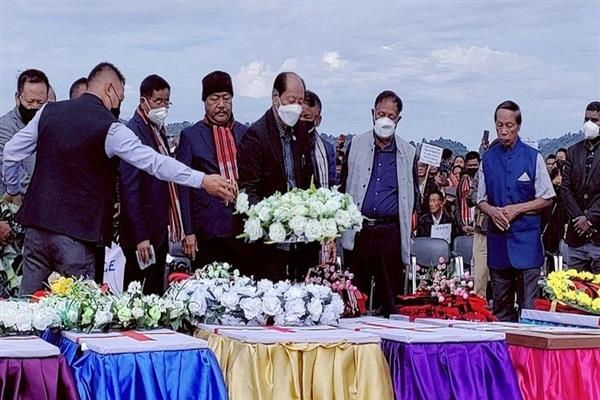
On the evening of December 4, 2021, 3 civilians were gunned down at Tiru-Oting area in Nagaland’s Mon district led by army men of the Assam Rifles, an Indian army unit, and an elite para-commando battalion which further resulted in the death of security personnel when the villagers retaliated, and another civilian was killed by the Assam Rifles personnel in Mon town the subsequent day when an angry mob stormed the Assam Rifles camp.
Army said it mistook a group of labourers for militants and opened fire, killing six. The army called it a "case of mistaken identity" but locals reject the claim. An Indian soldier and seven more people died as angry locals clashed with the troops in the region.
Indian Home Minister Amit Shah, who is responsible for domestic security, had expressed "deep anguish" over the incident, and the Nagaland state government formed a high-level inquiry led by a Special Investigation Team (SIT).
The Indian army said the soldiers had been responding to "credible intelligence inputs" about the movement of separatist guerrillas in the region, who often cross into Myanmar after attacking security forces.
"This is horrible and outrageous," said Sanjoy Hazarika, writer, and commentator on northeast India. He blamed "the omnibus protection provided to the security forces" under India’s Armed Forces Special Powers Act (AFSPA) as the "major obstacle to justice" in the troubled region.
AFSPA is a controversial anti-insurgent law that gives the security forces the powers of search and seizure. It also protects soldiers who may kill a civilian by mistake or in unavoidable circumstances during an operation. The law has been blamed for "fake killings" and campaigners say it is often misused.
In March, the Centre announced a partial lifting of the contentious Act in several pockets of the region including the areas of 15 police stations within Nagaland. The state police chief said a security grid has been set up with additional forces deployed to those areas and the state police are keeping vigil on security threats so as to ensure peace and tranquility.
Nagaland is home to India’s oldest ethnic rebellion, dating back to the 1950s. The armed movement revolves around the demand for an ethnic homeland – a sovereign territory that includes Nagaland and all Naga-habited areas of the neighboring states of Assam, Manipur, Arunachal Pradesh as well as Myanmar.