



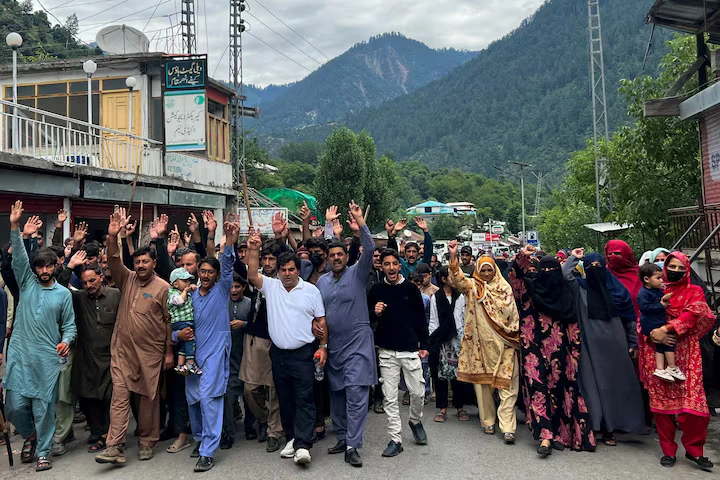
Srinagar, September 15: Internet and mobile services remain restricted in parts of Pakistan-controlled Kashmir more than 100 days after authorities imposed a communications blackout amid protests over electoral reforms and political representation in the region.
The restrictions were first imposed on June 5, when authorities banned the Jammu Kashmir Joint Awami Action Committee (JAAC), a grassroots coalition that had been campaigning for political and economic reforms. Internet-monitoring data and reports from the region indicate that connectivity has remained severely disrupted in several areas since then, although services have been partially restored in some locations.
The prolonged restrictions have disrupted daily life, including access to online banking, education, business and communication. They have also made independent reporting and verification of developments in the region more difficult.

The protests intensified ahead of elections to the 45-member Legislative Assembly, with the JAAC’s principal demand being the abolition of 12 seats reserved for refugees from Indian-controlled Kashmir who now live elsewhere in Pakistan.
The group has argued that the reserved seats allow political parties based in Pakistan to influence the formation of governments in Pakistan-controlled Kashmir and give representation in the regional legislature to people who do not reside there. The authorities have rejected the demand, while the Supreme Court of the region ruled in June that the seats are constitutionally protected and cannot be abolished without a constitutional amendment.
The electoral dispute was part of a broader 38-point charter of demands put forward by the JAAC. The charter also included demands relating to subsidised flour, electricity tariffs, hydropower benefits, governance, public services and alleged corruption.
The protests turned increasingly violent in June and July, with clashes between demonstrators and security forces reported in several areas, particularly in the Poonch division.
The unrest also affected the regional elections. The vote, originally scheduled for July 27, was split into three phases because of security concerns. The final phase was held on August 10 after voting in some constituencies was postponed.
The July 27 clashes in Rawalakot were particularly deadly. Amnesty International said at least 19 people were reportedly killed when security forces used lethal force against protesters, while other accounts put the overall death toll from the unrest considerably higher. Due to the communications restrictions and limited access to affected areas, casualty figures have been difficult to independently verify.
The internet shutdown has also drawn concern from rights and press-freedom organisations. Amnesty International called for communications services to be restored, saying the blackout was impeding independent verification of events.
Press-freedom groups have continued to raise concerns over the restrictions. In a letter to Pakistan Prime Minister Shehbaz Sharif this month, the Committee to Protect Journalists and other organisations said the shutdown in Pakistan-controlled Kashmir had severely limited journalists’ ability to report, communicate with sources and transmit material.
The restrictions come as political tensions remain unresolved in the region. The JAAC has continued to press for its demands, while authorities have maintained that the movement poses a threat to public order.
The prolonged communications restrictions have left parts of Pakistan-controlled Kashmir with limited access to the internet months after the protests first erupted, keeping residents, businesses and journalists dependent on patchy connectivity while the political fallout from the unrest continues.