Mir Syed Ali Hamdani’s presence continues to resonate deeply across Kashmir. Centuries after his arrival, the salutations he taught are still recited in mosques and shrines, and his influence remains visible not only in the spread of Islam but also in the region’s culture, craftsmanship and intellectual life.
Among the many narratives associated with the 14th-century Persian saint is a remarkable episode that religious texts link to the origin of Chehil-e-Asrar — The Forty Mysteries.
According to Manqabat al-Jawahir, a work by his close disciple Haidar Qawamuddin Badakhshi, the event took place during the holy month of Ramadhan. While the exact date is not specified, the account states that Mir Syed Ali Hamdani received invitations for iftar — the evening meal marking the end of the day’s fast — from forty people belonging to different households.
When Badakhshi conveyed the invitations to his master, the saint chose not to refuse a single one. Concerned, the disciple questioned him. Each host, he said, would prepare food according to their means. How would it be possible to attend so many gatherings in one evening? Should some invitations be declined?
“Do not refuse anyone. Let it be as it is,” Mir Syed Ali Hamdani replied.
As dusk settled into night, the saint performed his regular prayers, followed by two additional rakʿats in gratitude, and then withdrew into his chamber. According to Badakhshi’s narration, he did not emerge again that night.
Yet religious texts describe an extraordinary occurrence. Mir Syed Ali Hamdani, accompanied by four companions, is said to have visited each of the forty households that had invited him, partaken of their meals, and composed a poem for every host — all without being seen to leave his chamber.
The following morning, the saint’s servant recounts, Mir Syed Ali Hamdani stepped out and handed over a bundle of written pages. The servant found that the papers contained forty poems, composed in Persian.
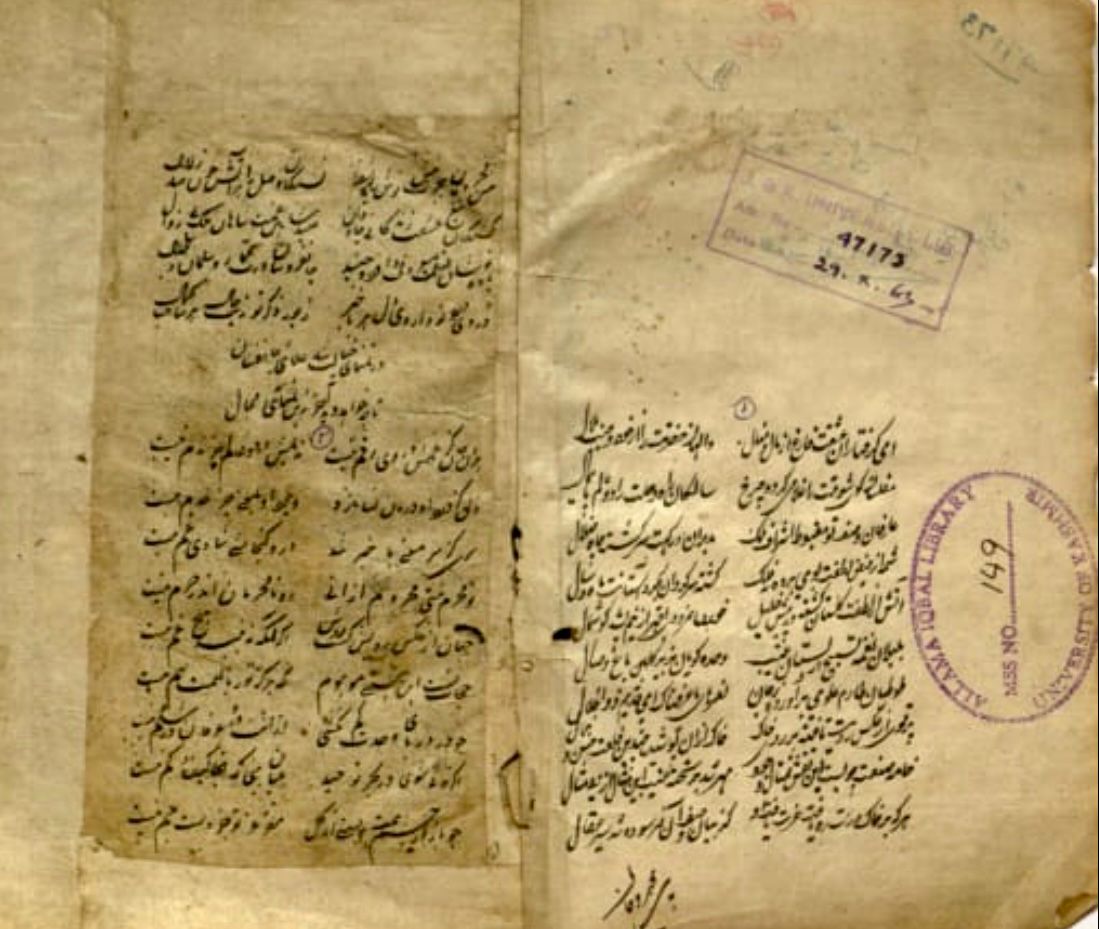
Confirmation, according to tradition, came soon after. Each of the forty disciples independently claimed that the saint had visited their home the previous night and presented them with a poem. When the writings were compared, they were found to be identical. The collection was later compiled under the title Chehil-e-Asrar, literally translating to The Forty Mysteries.
While religious scholars differ on the precise location where Chehil-e-Asrar was composed, there is broad agreement that Mir Syed Ali Hamdani travelled extensively during his lifetime, including across Central Asia and Kashmir. The work is believed to have been written during one such journey.
The poems of Chehil-e-Asrar centre on core spiritual themes: tawḥīd, the oneness of God; al-qadr, divine supremacy over all worldly and otherworldly powers; zuhd, or detachment from material desire; risālat, affirming the finality of the Prophet Muhammad’s (PBUH) mission; and ʿishq-e-rasūl, an expression of devotion and love for the Prophet.
What follows is an excerpt from Chehil-e-Asrar, translated from Persian by Zeeshan.
From Chehil-e-Asrar
Those seized by Your love care nothing for wealth or rank;
Even Paradise loses meaning for those drawn close to You.
True guides reduce power and pride to dust;
For seekers of Your nearness, both worlds are trampled underfoot.
Even the wise falter when they try to describe You;
Worldly rulers lose themselves in tangled words.
If even the cruel sensed the fragrance of Your mercy,
How could the heavens not?
The moon and time itself wander, bewildered, at Your threshold.
In the unseen garden, all beings sing Your praise;
Softly proclaiming Your Oneness, tasting intimacy with You.
By Your mercy, fire turned into a garden for Abraham;
And Nimrod was undone by something smaller than a mosquito.
From the highest heavens rise living voices,
Echoing the cries of ancient saints who truly knew You.
All worth and radiance come from a glimpse of Your beauty;
Even dust conceals countless forms of grace because of You.
Creation tried to capture the image of existence,
Yet its true form remains sealed in the unseen — without equal.
Whoever lowered himself to Your path found honor;
Those who relied only on speech wore their words thin.
For the wounded on Your way, even pain becomes healing;
For the thirsty for union, a drop feels like a flowing spring.
Those slain by the sword of Your love live forever;
Bearers of Your sorrow rule a kingdom without end.
Some drank deeply of Your love —
Others offered their lives in truth: ʿAmmār, Salmān, Bilāl.
Your pain is the cure for hearts that know;
Your remembrance adorns those perfected within.
In longing for union, Alāʾī gave his life —
What else could come of such an impossible desire?
This account is attributed to Qawamuddin Badakhshi’s Manqabat al-Jawahir.
Translation from Persian.