




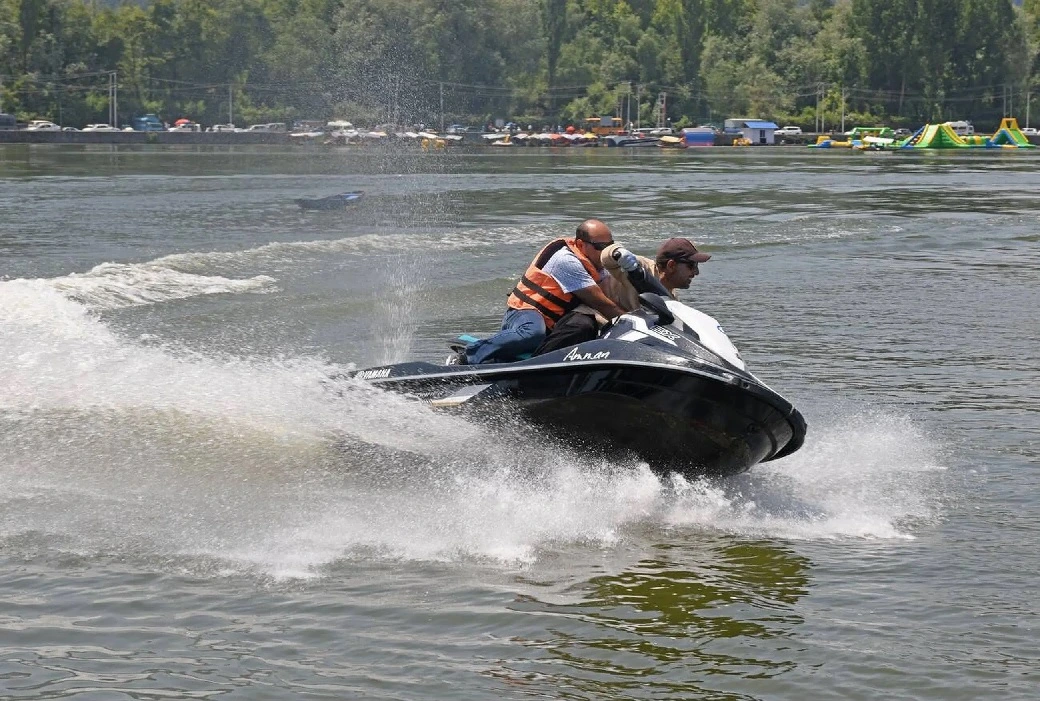
Srinagar, Oct 16: The High Court of Jammu and Kashmir and Ladakh has prohibited the operation of fuel-powered motorboats, including motorised shikaras, and jet skis on Dal Lake until further orders, directing authorities to strictly enforce the ban and warning that violations would amount to contempt of court.
The court has also directed the government to formulate a comprehensive policy on motorised boats in consultation with experts, balancing tourism interests with environmental protection and pollution control.
However, boats deployed by the administration for emergency services, law and order, disaster management and safety have been exempted from the prohibition.

A Division Bench comprising Chief Justice Dr Pushpendra Singh Bhati and Justice Rajesh Sekhri issued the directions while hearing a petition filed by Mohammad Rafiq Mir and others, according to a copy of the order accessed by the news agency Kashmir News Observer (KNO).
The Bench directed the Lakes Conservation and Management Authority (LCMA), Tourism Department and Police to ensure that no fuel-powered motorboat or jet ski operates on the lake, warning that any violation would attract contempt proceedings.
The authorities were also directed to take strict action against those found violating the court’s order.
The petitioners had raised concerns over the absence of uniform and transparent criteria for granting licences to motorboat operators, besides flagging the environmental impact of fuel-powered boats and jet skis on Dal Lake.
During the hearing, Senior Additional Advocate General Mohsin S. Qadri, appearing for the government, submitted that the authorities were committed to addressing pollution in the lake while ensuring that tourism interests were not adversely affected.
He informed the court that certain auctions relating to motorboats had taken place, while tourism licences had not been reviewed. He also assured the Bench that the government would adopt a scientific and expert-oriented approach to address the issues.
The court observed that the policy governing motorised boats must strike a balance between tourism, pollution control and uniformity among stakeholders.
It also pointed to the potential of solar-powered and electric boats as alternatives to conventional fuel-powered vessels, directing the government to explore replacing existing engines with cleaner technologies. The proposed policy, the Bench directed, sho