



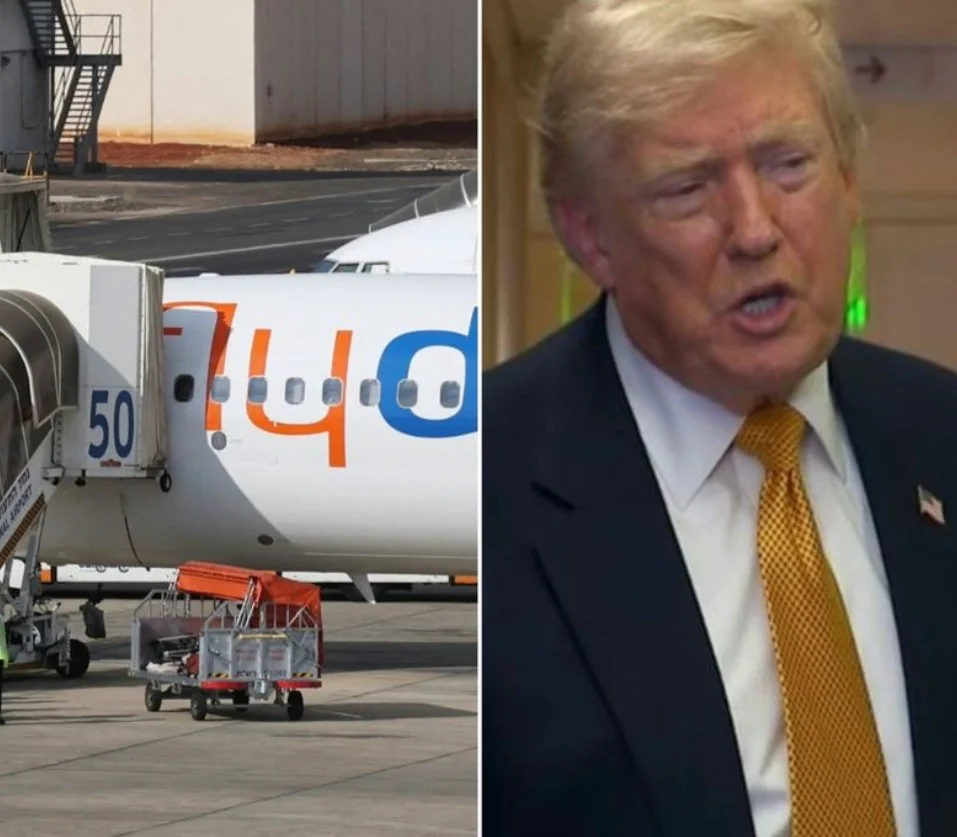
Washington, Oct 2: US President Donald Trump has warned that Iran would be hit “very hard” if investigators establish that Tehran was behind an alleged attempt by a copilot to crash a FlyDubai passenger plane bound for Israel.
Trump issued the warning on Thursday as investigators examined why the copilot allegedly stabbed the Indian captain and caused the Boeing 737 Max 8 to enter a steep descent before passengers and other crew members intervened and helped land the aircraft safely in Saudi Arabia.
Asked at the White House whether he had been briefed on possible links between the suspect and Iran, Trump said, “We’re working on it right now.”

“I would say the answer, based on what I’m hearing, is yes, but we’re working on it right now,” he said.
Asked whether the United States would retaliate against Tehran if Iran was found to be behind the incident, Trump replied: “Oh they’ll be hit, very hard, don’t worry.”
“You just ask them,” he added. “They know what happened. They’ll be hit very hard.”
The comments came amid a broader standoff between Washington and Tehran, with diplomatic efforts to end the seven-month war appearing to have stalled.
Iranian officials said Wednesday that Tehran had received an official US response to its latest proposal for ending the conflict. They did not disclose the contents of the response or say whether Washington had rejected the proposal.
In an interview with Time magazine published Thursday, Trump said he would not accept an Iranian proposal that contained terms “he wouldn’t have approved a year ago” and left open the possibility of renewed US bombing after the November 3 election.
The US military has also dispatched about 9,000 troops aboard a group of ships to the Middle East, according to a US official. The deployment could result in three aircraft carriers being in the region by late October, the official said.
Despite Trump’s public rejection of Tehran’s proposal, mediators have continued efforts to broker an agreement to end the fighting and reopen the Strait of Hormuz, according to officials familiar with the talks.
Passengers intervene after captain stabbed
The FlyDubai aircraft was carrying 182 people, most of them Israelis, from the United Arab Emirates to Tel Aviv when the incident unfolded.
Passengers said the wounded captain managed to open the cockpit door and allow them inside, after which several passengers grappled with the copilot and helped regain control of the aircraft.
The plane had reportedly descended from about 33,000 feet to 17,000 feet in roughly a minute, during a descent so severe that its rudder was torn away.
“We felt helpless, suspended in midair, and I didn’t know who to turn to. But it was all instinct to survive,” passenger Asaf Rajuan said in a statement shared by Israel’s presidency.
The aircraft was eventually diverted and landed safely in Saudi Arabia.
FlyDubai said the aircraft was secured by on-duty crew members who “diverted and landed the aircraft safely”. A regional official said those who intervened were pilots in training.
The Indian government said Captain Smit Machchhar, who was stabbed during the incident, was recovering in Abu Dhabi.
Suspect held as investigators examine possible motives
A regional official briefed on the investigation said the suspect, an Omani citizen, had been arrested. Saudi authorities were working with Israel and other countries, including the UAE, United States and Oman, to determine the motive, the official said.
Saudi Arabia later said the copilot had been handed over to the UAE.
“All possible scenarios, from terrorism to mental disorders, are being looked into. Nothing is ruled out for now,” the official said, speaking on condition of anonymity because the investigation remains ongoing.
The copilot has not been publicly identified.
Israeli Prime Minister Benjamin Netanyahu told Fox News that the suspect appeared to have entered the flight through a loophole in Israeli aviation rules that normally prevent pilots from countries without diplomatic relations with Israel from flying there. Oman does not have diplomatic relations with Israel.
Netanyahu also said it was “too early to say” whether there was any Iranian involvement.
Israel has requested that the suspect be transferred to Israel for questioning, according to a regional official. Israeli intelligence and security officials were already in Saudi Arabia to assist with the investigation.
The UAE said its own investigative team had begun examining the incident, including “whether it was linked to any terrorist purpose”, noting that the aircraft is registered in the UAE and that Emirati law applies to crimes committed aboard it.
Netanyahu said he had discussed the incident with UAE President Sheikh Mohamed bin Zayed Al Nahyan, who agreed that Israel should participate in the interrogation.
Trump said Wednesday that he had also discussed the incident at length with Netanyahu and described the copilot as possibly “a terrorist or perhaps a whack job.”
Oman’s government has not publicly commented on the incident.
Distress codes signalled emergency
The aircraft also transmitted two four-digit emergency codes while flying erratically near the Jordanian border with Saudi Arabia, according to Flightradar24.
The first, “7700”, is the standard emergency squawk used to indicate a serious problem. It was followed by “7500”, a code used to signal unlawful interference, including a possible hijacking.
Such codes can be used when pilots cannot safely communicate the nature of an emergency over radio.
The investigation is continuing, with authorities examining the copilot’s background, the circumstances surrounding the attack and any possible links to terrorism or outside actors.