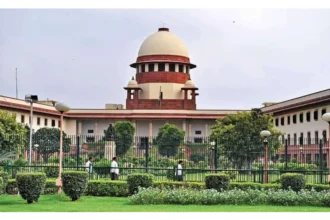




New Delhi, Mar 12 — The Supreme Court on Thursday granted bail to Kashmiri separatist leader Shabir Ahmed Shah in a militancy funding case, observing that the delay in completion of the trial could not be explained.
A bench comprising Justices Vikram Nath and Sandeep Mehta passed the order after hearing submissions from senior advocates Colin Gonsalves for Shah and Siddharth Luthra for the National Investigation Agency (NIA).
The court noted that Shah had been in custody since June 2019 and that the progress of the trial remained slow, with the prosecution expected to examine nearly 400 witnesses.

In his appeal, Shah argued that he had spent a prolonged period in incarceration while the trial had not progressed substantially.
“In the absence of any material against the appellant, the prolonged period of incarceration and the impossibility of a speedy trial with 400 witnesses to be examined by the prosecution, the appellant seeks bail,” his plea stated.
Shah had approached the Supreme Court after the High Court dismissed his challenge to a July 7, 2023 order of a special NIA court rejecting his bail plea.
He was arrested in June 2019 and later named as an accused in the second supplementary chargesheet filed by the NIA on October 4, 2019. The agency alleged that Shah played a role in building a separatist movement in Jammu and Kashmir, paid tributes to families of slain militants, and received funds through hawala channels and cross-Line of Control trade to finance “subversive and militant activities.”
Opposing the bail plea, the NIA told the court that several accused persons, including Shah, had conspired to raise and channel funds to disrupt peace in the Kashmir Valley and wage war against the Government of India.
During earlier hearings, the bench had asked the agency to place contemporary evidence on record rather than relying on decades-old speeches.
“These speeches are not new creation… they were present 30 or 35 years ago and now you recover them in 2019 and say these are inflammatory speeches,” Justice Mehta had remarked, questioning the relevance of such material to the present case.
The court had also earlier told the NIA to justify Shah’s continued detention beyond six years and to place supporting documents on record.
“Prima facie, we do not have any sympathy for people who indulged in these things, but facts should be there to justify their detention… We can’t just shut our eyes to the facts available,” the bench had observed.
During the hearing, the NIA said it had recovered inflammatory videos and emails from Shah’s premises and had sent digital material to the Centre for Development of Advanced Computing for analysis. The agency later informed the court that the CDAC report had been placed before the trial court as part of the third supplementary chargesheet.
After hearing the submissions, the bench granted bail to Shah, noting that the delay in the trial proceedings remained unexplained.