



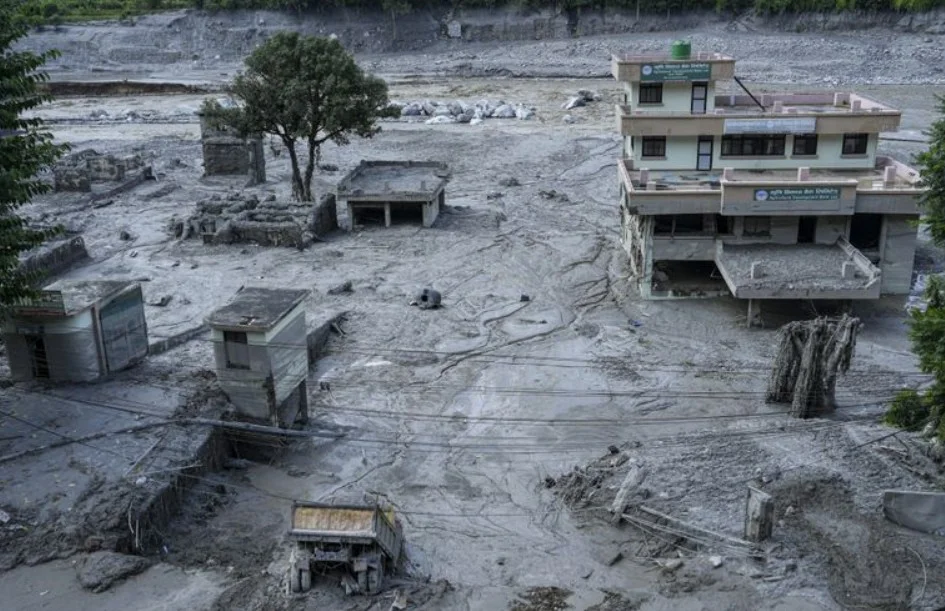
Kathmandu, Aug 28: The death toll from devastating flash floods in Nepal has risen to 469, while nearly 1,000 people remain missing in Nepal and neighbouring Tibet, authorities said Friday, as rescue teams searched through tonnes of mud and debris for survivors.
At least 540 of those missing are foreigners, with nationals from more than two dozen countries caught in the disaster that swept through Himalayan valleys and settlements along the Nepal-China border.
The disaster was triggered on Wednesday when a massive surge of water, rock, ice and mud tore through river systems, destroying villages, roads, bridges and power infrastructure along a key route connecting Kathmandu with Lhasa in Tibet.
Rescue operations continued with helicopters, heavy machinery and sniffer dogs, while emergency teams delivered supplies to thousands of people cut off by the floods.
But authorities were also racing to prevent a second disaster, warning that debris-blocked rivers and rising lakes could unleash another major surge.
Nepal’s disaster management authorities said a lake formed by debris blocking the Bhotekoshi River was rising and could burst. Across the border, Chinese authorities warned that about 3 million cubic metres of water could flow into an already dammed lake over the next three days.
“The volume of water is continuing to increase, and so is the risk,” Zhu Jinfeng, a researcher with China’s hydrology department, told state broadcaster CCTV.
Chinese authorities said the lake could breach around September 1, with peak water flow expected around that time.
Border crossing devastated
The worst-hit areas on the Chinese side included Gyirong County, where the strategically important Gyirong border crossing was struck by torrents of muddy water and debris.
Chinese rescuers had not yet reached the worst-hit areas by Thursday evening as crews worked to clear debris from the main access road.
CCTV reported that 558 people were missing in Gyirong County, including 260 foreign nationals. Three deaths had so far been confirmed on the Chinese side.
Dramatic footage from the area showed floodwaters carrying huge amounts of mud and debris sweeping through structures at the border crossing within seconds.
Chinese Premier Li Qiang visited the disaster zone in Gyirong on Thursday, signalling the scale of concern in Beijing over the devastation.
Survivors describe sudden deluge
In Nepal, survivors described little warning before the floodwaters surged through settlements.
“The flood came in suddenly and exploded like a bomb,” survivor Janak Bahadur said in Devighat. “The river looked small from a distance but it suddenly started overflowing and swept through.”
In the hard-hit town of Rasuwa, survivor Dibga Tamang was among those rescued and airlifted to an army camp in Nuwakot.
“All of our people have gone. They are dead,” Tamang said.
“I have no one left waiting for me. Everything and everyone is gone. The end.”
Foreign nationals among missing
The scale of the disaster has prompted several countries, including India, Australia and South Korea, to assist with rescue and relief efforts as authorities attempt to locate missing foreign nationals.
Nepal Prime Minister Balendra Shah, who visited flood-hit Nuwakot on Thursday, said government agencies were working at full capacity.
“All the state agencies are operating at full capacity. Our first priority now is to save life of each citizen, search and rescue of the missing, treat the injured and provide immediate relief to the affected families,” Shah said.
The disaster poses a major challenge to Shah’s five-month-old government. Officials, however, said Nepal had extensive experience in responding to large-scale disasters, including the 2015 earthquake that killed nearly 9,000 people.
With rescue teams still unable to reach some isolated areas and the threat of further flooding growing, authorities remained focused on finding survivors while preparing communities downstream for another possible surge.