



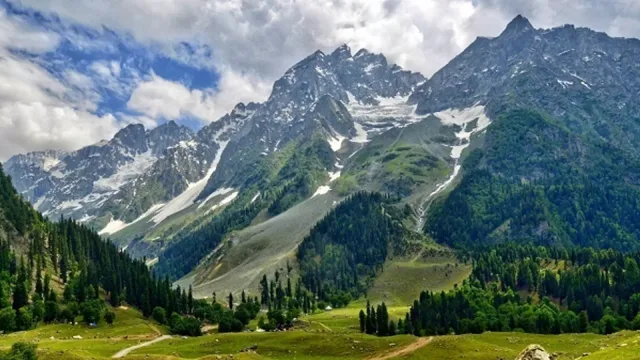
NEW DELHI, August 18: The western Himalaya, comprising Ladakh, Jammu and Kashmir and Himachal Pradesh, is warming faster than the central and eastern stretches of the Himalayan range in every season, according to a new study based on 120 years of temperature records.
The study also found that winter temperatures are rising faster than those in spring, while night-time temperatures are increasing faster than daytime highs across the western and central Himalaya.
The findings raise concerns over future snow accumulation and water availability, with researchers projecting substantially greater spring snow loss in the western Himalaya by the end of the century under a high-emission scenario.

Titled Vulnerability of the Himalayan Region Under Climate Change, the study was published in the Journal of Earth System Science. It analysed observed temperature and snow-cover changes from 1901 to 2020 across three sectors of the Indian Himalayan range and projected how those trends could evolve through 2100.
The research was led by the Department of Remote Sensing and Geoinformatics at Birla Institute of Technology (BIT), Mesra, Ranchi, in collaboration with the Indian Institute of Tropical Meteorology (IITM), Pune, and Ashoka University.
“The Himalaya is often discussed as a single system, but our observations and models both say otherwise,” said Protyusha Mukhopadhyay, lead author and researcher at BIT, Mesra.
“The western Himalaya consistently emerges as the most sensitive stretch — it warms the most and loses the most snow under every pathway we tested. That has direct consequences for the states that sit in it,” she said.
Western Himalaya faces sharpest warming
Under a high-emission pathway, winters during 2081-2100 could be 7.18°C warmer in the western Himalaya compared with the early 1900s, the study projected.
The corresponding increase was estimated at 6.71°C in the central Himalaya and 5.82°C in the eastern Himalaya.
Researchers said the difference between the three sectors demonstrates why the Himalayan region cannot be treated as a uniform climatic zone.
Parthasarathi Mukhopadhyay, corresponding author and researcher at Ashoka University, said the faster winter warming could have significant implications for snow accumulation.
“In the west and centre, winters are warming faster than springs. Less snow on the ground would mean a darker surface, which absorbs more heat, which melts more snow,” he said.
“It matters because winter is the season in which snow is supposed to build up; warmer winters mean less snow banked for the melt months that follow,” Mukhopadhyay added.
Nights warming faster than days
Another prominent finding was the faster rise in night-time temperatures across the western and central Himalaya.
Researchers said the trend could alter the timing and pace of snowmelt, even beyond changes in the overall amount of snowfall.
“Rising night-time temperatures are the quieter half of this story, and arguably the more consequential one,” said Dr Swagata Payra, co-author and researcher at BIT, Mesra.
“When the cold nights that let snowpack recover start disappearing, you change the melt cycle itself — not how much snow falls, but when the water arrives downstream,” Payra said.
Spring snow loss emerges as major concern
The study found that snow loss was greater in spring than in winter across all three Himalayan sectors, with the western Himalaya recording the largest decline.
The researchers measured snow loss in terms of the amount of snow, by weight, present on each square metre of ground.
Under the study’s projections, the western Himalaya could experience springtime snow loss that is three times higher by the end of the century under a high-emission pathway than under a low-emission scenario.
The researchers said the findings point to a growing climate sensitivity in the western Himalayan region, with potential implications for snow-fed water systems and the timing of water availability downstream.
The study’s projections through 2100 underline the importance of limiting emissions while accounting for regional differences in Himalayan warming and snow-cover changes.